

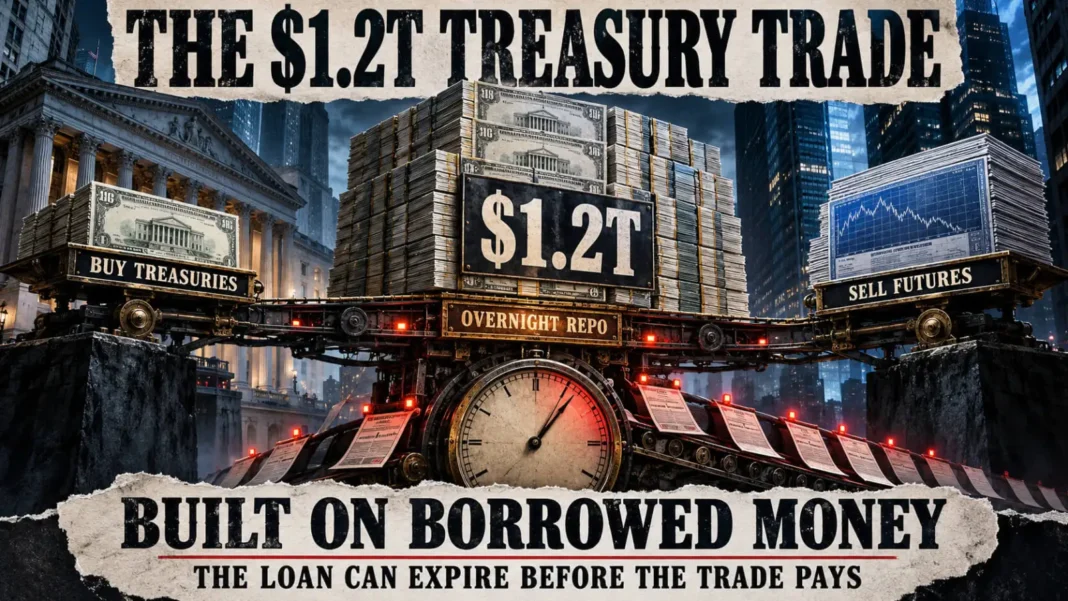

Corporations can hold massive amounts of US government debt without betting that bond prices will increase. By purchasing Treasury securities and simultaneously selling futures against them, hedge funds capture a slim pricing spread—largely by borrowing the majority of the acquisition funds to make the profit worthwhile.
In return, the government gains another buyer whose commitment lasts precisely as long as the trade remains profitable.
The catch is that these loans can expire overnight while the underlying trades require significantly more time to mature. The government’s absolute capacity to service its debt does not relieve a fund of its obligation to repay its specific lender.
This dynamic is known as the Treasury cash-futures basis trade, and the capital involved reaches far beyond the standard bond desk. According to reports from September 24, Morgan Stanley estimated that these positions had dropped by 20% this year to roughly $1.2 trillion.
At the time, the bank found no evidence of widespread basis-related market distress, indicating that a smaller volume of trades does not automatically signify an impending collapse.
Hedge funds love small profits when it’s someone else’s money
Investors can buy a Treasury security outright or trade a futures contract that locks in terms today for a settlement at a future date. Because the contract defines which securities can be delivered against it, their prices are linked without becoming identical.
When futures grow sufficiently expensive relative to an eligible bond, a fund will purchase the bond and sell the futures. Investors seeking bond-market exposure via contracts take the opposite side of the transaction, leaving the fund to hold the physical securities.
Selling futures serves as the hedge: if bond prices drop, the short position generates gains that neutralize a large portion of the bond’s decline. The fund captures the pricing gap as the contract nears delivery while minimizing its exposure to broader market movements.
To finance the bond purchase, the fund utilizes a repo, or repurchase agreement. The fund sells the security for cash and agrees to buy it back later at a slightly higher price—an arrangement that functions economically as a loan secured by the bond.
Because these are overnight repos, the fund must continually renew or replace the financing to maintain the position.
Consider a hypothetical $100 million position generating a net annual return of 0.2% after accounting for trading and financing expenses. That yields $200,000, which translates to a 4% return if the fund has put up just $5 million of its own equity.
However, if borrowing costs for the remaining $95 million rise by 0.2% over the year, the additional interest bill comes to $190,000. Nearly the entire projected profit goes straight to the lender, even though the government has not defaulted on anything.
The Office of Financial Research factors in the cost of futures margins alongside the seller’s options regarding which eligible bond to deliver and when. Calculating the actual return requires valuing those delivery rights while accounting for both financing and margin expenses.
When that math ceases to look appealing, a fund can simply stop rolling over positions as they expire. Professional investors do not require a crisis to redirect their capital elsewhere.
Being right doesn’t pay today’s bill
Even if the hedge is sound, a fund may lack the cash required to keep the position active.
Imagine a scenario where the bond increases in value while the short futures position suffers an equivalent loss. The futures account may demand a cash payment to cover that loss—known as variation margin—while the gains on the bond remain locked inside the security.
The fund is then forced to extract cash from that asset or source it from elsewhere before the payment deadline.
Crypto traders holding profits on one exchange while facing a liquidation on another will recognize this challenge: funds trapped in the wrong account will not satisfy an urgent margin call, and explaining the logic of a hedge will not extend the deadline.
Repo lenders can also demand extra capital. If a lender provides $98 against $100 worth of bonds, the fund contributes the remaining $2, representing a 2% haircut. If that haircut climbs to 4%, the fund must double its own cash contribution against that exact same collateral, long before accounting for any futures margins.
Should numerous funds be forced to unwind positions simultaneously, they must sell bonds to pay off loans and purchase futures to cover their short positions. Such synchronized trading can depress bond prices relative to futures, penalizing other funds holding identical positions and driving up their exit costs.
This type of forced liquidation differs from simply letting trades expire without replacement, though both actions shrink outstanding positions. A reported market contraction on its own cannot reveal which scenario is unfolding.
In research published this June, Federal Reserve analysts estimated that basis positions totaled $830 billion as of September 2025. Because that figure and Morgan Stanley’s more recent estimate rely on different methodologies, treating them as consecutive data points creates a comparison the numbers do not support.
Furthermore, total hedge fund Treasury holdings—and their short futures positions—encompass various other strategies as well.
Someone still has to own the Treasury bonds
A reduction in trades reliant on overnight borrowing can render the market less vulnerable, provided that incoming owners bring stable financing capable of weathering a difficult week. Investors purchasing assets with fully committed capital do not engage in daily negotiations with repo lenders.
Such buyers may demand better pricing because they are acquiring bonds strictly for income. Cheaper bonds deliver higher yields, stimulating replacement demand while potentially increasing the cost of new government borrowing.
Dealers can hold bonds temporarily while sourcing ultimate buyers, but their capacity is limited and carries costs. Consequently, an orderly market transition may leave Washington paying higher rates without triggering a market breakdown.
Elevated repo rates or larger haircuts become deeply concerning if funds are compelled to dump assets into a market lacking willing buyers. Those financing terms and current seller prices offer far more insight into actual market stress than aggregate position totals alone.
The same caution applies to Bitcoin, as the wider balance sheets of hedge funds demonstrate why a single trading strategy cannot account for all activities these firms undertake.
Linking Treasury market troubles to cryptocurrency requires concrete proof that the involved institutions are actually selling crypto or pulling financing, rather than assuming every liquidity need ends in a Bitcoin liquidation.
Ultimately, borrowed money is what motivates these funds to hold bonds for returns that would otherwise be far too small to pursue.
When that equation breaks down, shifting away from these trades can lessen the market’s reliance on overnight loans, but replacement buyers may demand higher yields to take the debt off their hands.
Frequently Asked Questions
What is the Treasury cash-futures basis trade?
It is a strategy where hedge funds buy Treasury securities and simultaneously sell futures contracts against them to capture a small pricing gap. Because the profit margin is slim, funds borrow most of the purchase money to make the return worthwhile.
Why do hedge funds rely on repo loans for this trade?
Repo (repurchase agreement) financing allows funds to put up only a fraction of their own capital—often just a few million dollars out of a $100 million position—while borrowing the rest. This leverage turns tiny percentage returns into much more attractive profits.
What happens if borrowing costs or margin requirements rise?
If borrowing costs increase or lenders demand larger haircuts and variation margins, the expected profits can be entirely wiped out. If funds cannot meet these cash demands or renew their loans, they may be forced to quickly unwind their positions.
How large is the Treasury basis trade market?
Morgan Stanley estimated that these positions had fallen 20% this year to roughly $1.2 trillion in late September, though bank reports found no evidence of widespread market stress at that time.
Do lower basis trade volumes mean the bond market is safer?
Fewer trades dependent on overnight loans can reduce systemic fragility if new buyers use fully committed capital. However, those replacement buyers may demand cheaper bonds and higher yields, potentially raising the government’s borrowing costs.