

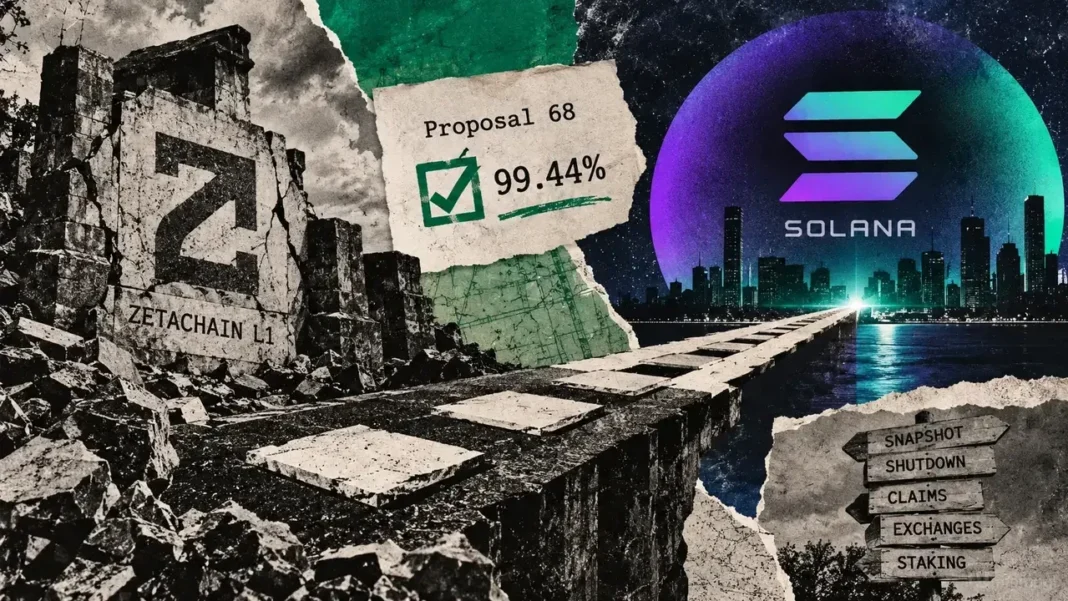

ZetaChain’s on-chain governance has greenlit the retirement of the network’s standalone blockchain, paving the way to transition ZETA to Solana as the initiative shifts its focus toward private artificial intelligence.
Following the conclusion of voting on Sept. 20, Proposal 68 secured approval with approximately 99.44% of the ballots in favor. The final on-chain count recorded 263.65 million ZETA supporting the motion, 744,658 opposed, and 752,300 abstaining, granting core contributors a mandate to organize the upcoming migration.
The vote does not immediately relocate tokens or decommission the live network.
ZetaChain says its own L1 no longer fits
This planned shutdown represents a major strategic pivot for an initiative established in 2021 to bridge otherwise isolated blockchains.
Over the course of several years, ZetaChain developed a Cosmos SDK-based layer-1 network intended to allow applications to interact seamlessly with assets and smart contracts across platforms like Bitcoin, Ethereum, and Solana. Earlier in the year, however, the team redirected its resources toward Anuma, a private multi-model AI application built around a framework designated as a Private Memory Layer.
ZetaChain now asserts that maintaining its own independent blockchain no longer serves that objective. Within Proposal 68, the project noted that managing a Cosmos-based network necessitates tracking and coordinating upstream security advisories and patches across dozens of separate validators—an administrative burden anticipated to grow as AI-driven tools simplify the discovery of vulnerabilities.
Transitioning to Solana would eliminate the need for this validator infrastructure, allowing contributors to concentrate fully on Anuma and the broader AI application layer. ZetaChain stated that “every contributor hour” will be redirected toward ZETA, Anuma, and development on Solana.
According to the project, Anuma has drawn over 300,000 users since February and handled upward of 1 million requests spanning 35 AI models. Because every Anuma account incorporates a built-in wallet, the migration could introduce those participants directly into the Solana ecosystem alongside the token.
ZetaChain contends that Solana supplies the transaction velocity, minimal fees, deep liquidity, and emerging agent-payment utilities required for AI applications that execute frequent micropayments or model queries. The project highlighted Solana’s roughly 400-millisecond confirmation times, more than $15 billion in native stablecoins, and nearly $70 billion in monthly decentralized exchange volume.
ZETA shifts from securing a chain to accessing AI
The impending token migration will also redefine ZETA’s economic function within the ecosystem.
Native balances residing on ZetaChain will convert on a 1:1 basis into a Solana-native SPL token retaining the identical ticker symbol. The overall token supply will remain fixed, with zero newly minted units. Upon completion of the migration, the Solana-based asset will serve as the canonical edition of ZETA, while ZetaChain’s custom layer-1 will officially sunset.
The organization is rebranding ZETA as an access token for its AI services rather than positioning it primarily as the collateral securing an independent proof-of-stake network.
Anuma already permits users to lock up ZETA in exchange for service credits applied to AI consumption, effectively removing those coins from active circulation. ZetaChain intends for external AI applications and automated agents operating on Solana to adopt this exact mechanism.
The viability of this strategy hinges on Anuma’s capacity to translate early user growth into enduring demand and whether third-party developers choose to embrace ZetaChain’s memory layer.
While the migration grants the token exposure to Solana’s expanded trading and payment infrastructure, it simultaneously dissolves the sovereign blockchain that previously served as the bedrock of ZETA’s utility.
Holdings of ZETA maintained on Ethereum and the BNB Chain remain untouched by Proposal 68, and existing token vesting schedules will persist unchanged. Native balances migrating from ZetaChain will shift from 18 decimal places to Solana’s standard nine and be rounded down, though the initial proposal leaves the precise handling of any fractional remainders unaddressed.
Exchanges now hold part of the timetable
The subsequent phase relies heavily on the centralized exchanges that currently support ZETA trading pairs.
Core developers indicated that a second governance proposal will only be submitted after these trading platforms formally specify how they plan to accommodate the token swap. Because major exchanges demand advance notice for network migrations, the ultimate timeline for the shutdown depends on those ongoing negotiations rather than a fixed calendar date.
The upcoming follow-up proposal is anticipated to outline the withdrawal period for assets still housed on ZetaChain, specific snapshot and halt block heights, the activation timeline for Solana claims, and procedures for converting exchange-held balances. It will also detail user protections and the formal wind-down process for validators.
The future framework for staking remains undecided. Staking rewards will persist uninterrupted until the layer-1 network ceases operations, and ZetaChain notes that it is still evaluating what form staking might take following the move to Solana.
Until cryptocurrency exchanges agree on these logistical details and token holders ratify them, ZetaChain will keep running the infrastructure it has voted to decommission.
Frequently Asked Questions
What did ZetaChain’s Proposal 68 approve?
Proposal 68 approved retiring ZetaChain’s standalone Cosmos SDK-based layer-1 blockchain and migrating the ZETA token to Solana as the project shifts its focus to private AI applications like Anuma.
Will the token migration change the total supply of ZETA?
No, native balances on ZetaChain will convert 1:1 into a Solana-native SPL token under the same ticker symbol, and total supply will remain completely unchanged with no new tokens created.
What happens to ZETA tokens held on Ethereum or the BNB Chain?
Tokens held on Ethereum and BNB Chain are unaffected by Proposal 68, and existing vesting schedules will also remain unchanged.
When will the network officially shut down?
There is no fixed shutdown date yet. The timeline depends on negotiations with centralized exchanges regarding how they will support the token swap, followed by a second governance proposal.