

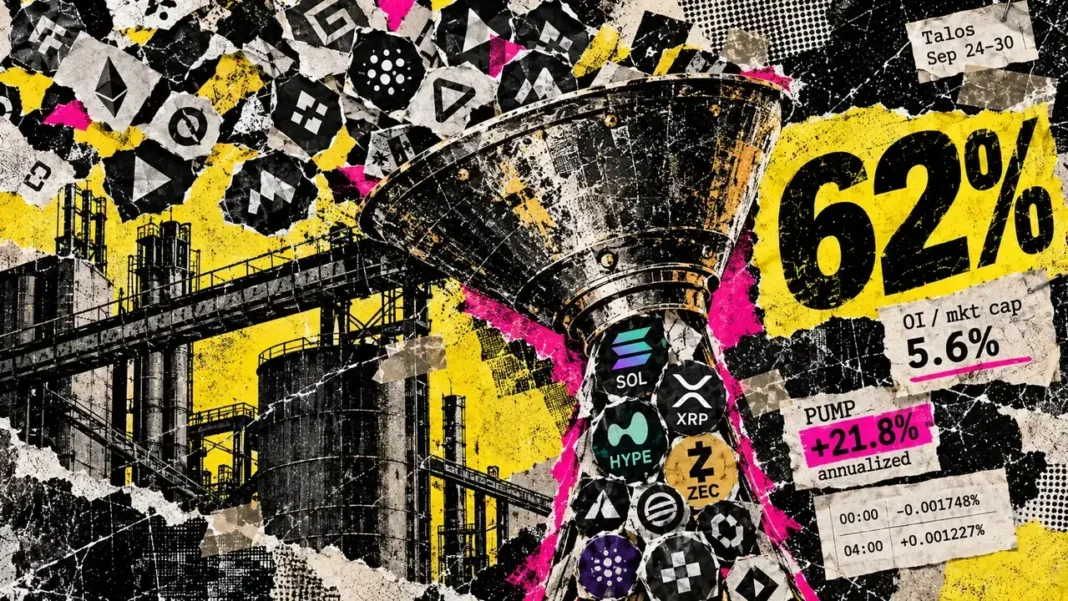

According to Talos’s weekly market report for September 24–30, 2026, ten tokens accounted for 62% of all outstanding altcoin futures exposure, also known as open interest. This concentrated market exposure came with varying financing costs, as the report noted SOL funding dipped below zero while PUMP funding hit an annualized rate of +21.8%.
The market publication, released on October 1, also showed altcoin open interest at 5.6% relative to market capitalization, marking a record high within Talos’s data series. These figures highlight a heavily concentrated derivatives footprint for traders entering the October trading week, while subsequent Binance settlements demonstrate how rapidly the cost to hold a specific contract can fluctuate.
Funding pressure can change within hours
Perpetual futures utilize funding payments to keep contract prices tied to the underlying market. Per Hyperliquid’s funding mechanics, positive rates mean long holders pay short holders, while negative rates reverse the flow. Consequently, a trader’s financing expenses vary by contract, trading side, and funding interval, even when two separate tokens maintain high open interest.
The October 5 update examines two Binance contracts instead of providing an exact match to Talos’s altcoin aggregate. Their settled payment records, pulled shortly after 04:20 UTC, revealed positive SOL funding alongside a PUMP rate that switched signs inside a four-hour window.
| Binance contract | Settlement, Oct. 5, 2026 (UTC) | Native settled funding rate | Paying side |
|---|---|---|---|
| SOLUSDT | 00:00 | +0.010000% | Longs pay shorts |
| PUMPUSDT | 00:00 | -0.001748% | Shorts pay longs |
| PUMPUSDT | 04:00 | +0.001227% | Longs pay shorts |
The prior observed payment for SOL occurred at 16:00 UTC on October 4 at +0.010000%, falling eight hours ahead of the midnight settlement. Meanwhile, PUMP’s two recorded payments stood four hours apart.
At midnight, PUMP’s payment charged short positions, whereas its 04:00 payment charged longs. This shift demonstrates how financing costs can reverse even while the underlying contract stays identical. Additionally, SOL’s positive midnight payment contrasts with the negative funding noted in the earlier Talos data snapshot.
Annualizing periodic rates provides a unified standard for comparison rather than locking in annual costs. Documentation from Coin Metrics differentiates the active period of a rate from the input window utilized for its calculation. Hyperliquid conducts hourly settlements by dividing an eight-hour formula into hourly increments.
Coin Metrics’ aggregation method weights normalized market rates based on dollar open interest and scales longer aggregate spans linearly. Its daily series acts as a boundary sample rather than a true daily average. While these definitions clarify existing metrics, they do not pinpoint the exact calculation series or averaging window behind Talos’s +21.8% PUMP figure.
What the concentration figures measure
Among the top ten markets in its group, Talos highlighted SOL, XRP, HYPE, and ZEC. The 62% figure pinpoints where exposure rested inside its monitored altcoin category. To determine if these tokens held unusually large derivatives positions relative to their scale, one would need to compare their exposure share against their share of total market value using identical assets and timestamps.
The report’s text leaves out the historical launch date and the exact treatment of ETH. These omissions keep the figures strictly tied to Talos’s series and prevent translating the 62% concentration into an assertion of excessive market crowding.
The 5.6% ratio addresses a distinct metric: the magnitude of outstanding exposure compared to the value of the tracked tokens. Coin Metrics’ capitalization standards separate the value of currently issued supply from estimated circulating supply and free-float supply. These frameworks can yield differing valuations for the identical token, particularly when supply remains locked in escrow or held by strategic investors. Because the report does not specify which convention forms its denominator, the 5.6% figure remains specific to Talos rather than serving as a universal leverage benchmark for altcoins.
Under standard definitions of open interest, every open contract involves a buyer and a seller, with only one side counted. Open interest consequently measures unresolved contractual positions.
Dollar values introduce another layer of distinction. Market data fields on Binance separate outstanding asset quantities from their dollar value. Higher dollar totals may stem from price shifts, volume changes, or a combination of both. For a single linear contract featuring a matched price basis along with static quantities and supply definitions, price movements can cancel out within the ratio. However, across an entire basket of assets, relative prices and constituents continue to play a role.
The updated exposure data points are similarly granular. Binance recorded roughly $1.045 billion in SOLUSDT open interest value at 04:20 UTC on October 5, alongside roughly $142.876 million for PUMPUSDT at 04:15 UTC.
Concentrated positions can share collateral
Talos viewed its exposure concentration as a factor that confines risk to a small number of tokens. Its sector review on September 29 also characterized the market rally as being of higher quality.
Margin rules on Hyperliquid highlight why this differentiation is critical. Cross margin distributes collateral across eligible holdings, whereas isolated margin restricts collateral to a single position. When collateral is shared, losses in one holding can jeopardize the assets backing another. The extent of this risk-sharing relies on the chosen account mode and active markets.
Liquidation protocols activate when account equity drops beneath maintenance thresholds. The platform first attempts to wind down positions via the order book, relying on a backstop mechanism under defined conditions. Losses from other cross-margin positions and ongoing funding payments can directly influence an account’s true liquidation threshold.
An exposure percentage alone cannot disclose account balances, proximity to liquidation, or the depth of the order book. Therefore, it cannot prove that a liquidation cascade is certain or that risk is strictly isolated to the tokens boasting the highest open interest.
Previous CryptoSlate reporting on ETF concentration and altcoin spot turnover explored other elements of market rotation. Fund flows track allocations, turnover measures trading activity, open interest tracks active contracts, and funding rates reflect periodic financing costs.
For market participants analyzing this environment, the next essential data points include a matched comparison of exposure against token value, a sequence of settled funding payments, and a clear view of the collateral and liquidity backing these positions. While the reported 62% concentration serves as a baseline for evaluation, the October 5 settlements prove how fast the associated financing costs can shift.
Frequently Asked Questions
What percentage of altcoin futures exposure did the top ten tokens hold?
According to Talos’s market report for September 24–30, 2026, ten tokens accounted for 62% of outstanding altcoin futures exposure (open interest).
How was altcoin open interest measured relative to market capitalization?
The report recorded altcoin open interest relative to market capitalization at 5.6%, which represents a record high within Talos’s data series.
Did all top tokens share the same funding burdens?
No. Talos reported SOL funding below zero, whereas PUMP funding reached an annualized rate of +21.8%.
How quickly can funding rates change for perpetual futures contracts?
Funding rates can reverse direction within hours; for example, Binance records showed a PUMP contract shift from charging shorts to charging longs within a four-hour window on October 5, 2026.
Why does shared collateral pose a risk for futures traders?
Platforms using cross-margin pool collateral across eligible positions, meaning that losses or funding payments from one holding can impact and endanger the resources supporting other positions in the same account.