

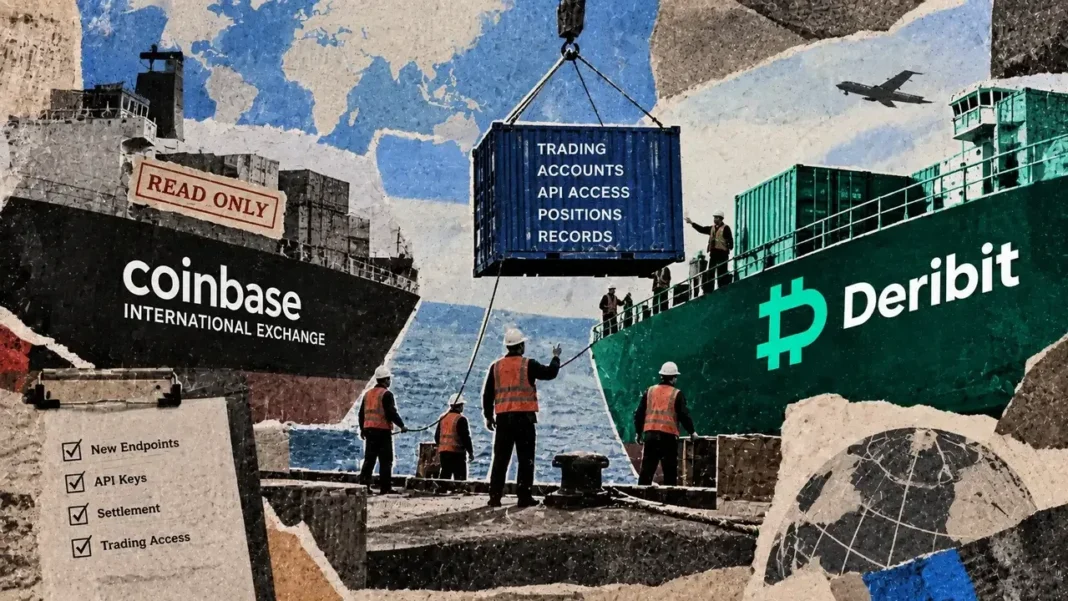

Coinbase successfully finalized the transition of Coinbase International Exchange to Deribit on Oct. 1, 2026, officially halting trading on its legacy international platform. The previous exchange now operates solely in read-only mode, with all ongoing trading activity shifted over to Deribit.
According to Coinbase’s migration status updates, maintenance wrapped up at 10:02 UTC on Oct. 1, 2026. For impacted institutional clients, this change immediately introduces new operational requirements, including updated trading connections, a modified settlement cycle, and separate historical data records.
These affected institutional accounts are restricted to non-US institutions located in specific jurisdictions. Coinbase notes that this consolidation brings together derivatives liquidity that was previously divided between the two separate platforms. Product availability and access continue to depend on both user location and account classification.
Institutions relying on FIX or API connections must adopt Deribit endpoints alongside freshly generated Deribit API keys, as old International Exchange keys are no longer valid. Furthermore, there was no overlapping parallel trading window on the old platform.
Deribit’s API transition documentation highlights that API-key IP allowlists do not automatically carry over. Order attributes and instrument names have changed, and any open orders on the International Exchange were canceled during the halt rather than migrated. Traders looking to restore these canceled orders must manually recreate them on the new platform.
While execution now happens on Deribit, the institutional legal framework maintains a distinct structure. Coinbase institutional documentation indicates that Coinbase Bermuda Limited serves as the primary counterparty, custodian, and broker for these clients, routing their orders directly to Deribit.
Perpetual positions that were migrated now settle once per day at 08:00 UTC, replacing the International Exchange’s previous five-minute settlement cycle. This daily settlement applies profits or subtracts losses directly from cash balances without requiring positions to be closed. Funding accumulates continuously and undergoes cash settlement at that same daily timestamp, while the quoted eight-hour rate functions as a distinct convention.
Handling trade histories also demands attention. Block-trade entries labeled with the “Migration” tag re-establish positions using the International Exchange settlement price. These act merely as bookkeeping entries rather than genuine market buy or sell orders. Any discrepancy between that price and Deribit’s market mark upon reopening can generate immediate unrealized gains or losses.
Deribit does not display legacy trading history from the International Exchange. Coinbase states that historical trade and order APIs will remain accessible for roughly 12 months following the migration, meaning institutions must manage separate records for activity before and after the cutover.
For standard Coinbase website and app users, the account experience differs: they maintain their current Coinbase accounts and familiar core workflows, though market data displays and interfaces may experience adjustments. Customers utilizing the Coinbase Advanced Trade API for derivatives still require the newly introduced Deribit-powered gateway.
Additionally, the transition does not immediately make every derivatives product universally available. Coinbase continues to maintain a separate distinction for its CFTC-regulated Coinbase Derivatives futures, and US Prime options access follows an alternate schedule. Its retail FAQ outlines plans to roll out in-app options for eligible users in designated non-US regions starting in late October, dependent on availability.
Frequently Asked Questions
When did the migration of Coinbase International Exchange to Deribit finish?
The migration completed on Oct. 1, 2026, with maintenance officially marked complete at 10:02 UTC.
Are old API keys from the International Exchange still valid?
No. Institutions must use newly created Deribit API keys and endpoints, as old keys do not work and IP allowlists do not automatically transfer.
What happened to open orders that were active during the switch?
Open International Exchange orders were canceled at the halt rather than transferred, requiring clients to manually recreate them on Deribit if desired.
How often do migrated perpetual positions settle now?
Migrated perpetual positions settle once a day at 08:00 UTC, replacing the former five-minute settlement cycle.
Can users still access their historical trade data from the old exchange?
Yes, historical trade and order APIs for the legacy International Exchange will remain accessible for roughly 12 months post-migration, though this data does not appear on Deribit.