

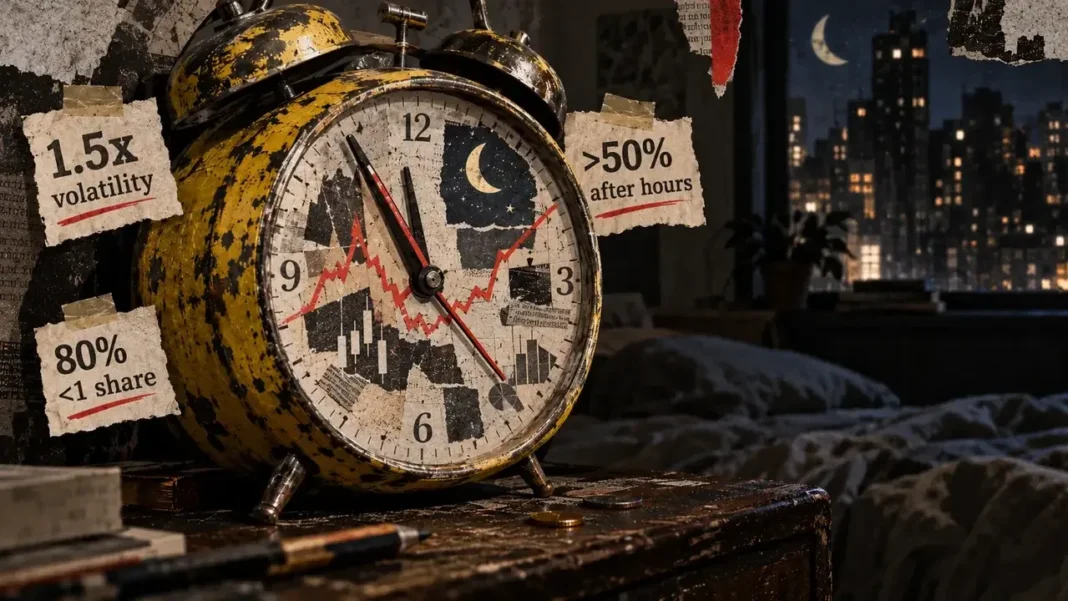

Research published by the International Monetary Fund (IMF) reveals that over 50% of sampled tokenized US stock trading takes place outside the normal operating hours of Wall Street.
The IMF’s October Global Financial Stability Report additionally indicated that roughly 80% of tokenized equity trades involved fractional amounts of less than one share. This highlights a clear interest in both round-the-clock access to American securities and fractional investing.
At the same time, the research noted that tokenized equities suffered from roughly 50% higher realized volatility than conventional equivalents, while fragmented trading platforms provided noticeably weaker liquidity.
These insights arrive as financial institutions and exchanges ramp up initiatives to move US equities onto blockchain architecture, which could disrupt traditional market schedules and settlement procedures.
Tokenized stock prices reflect overnight market activity
The IMF evaluated five prominent tokenized US equity products from xStocks and Ondo, focusing on exposure to Nvidia, Alphabet, Tesla, the Nasdaq, and the S&P 500.
Over a span of 365 trading days, the study analyzed 11 decentralized and centralized trading platforms, gathering more than 2 million observations of five-minute prices and trading volumes.
As of July 31, these examined products accounted for approximately $345 million in market value, translating to 15% of the total $2.3 billion tokenized equity market.
The data demonstrated that investors actively took advantage of capabilities unavailable during standard US stock-market sessions.
More than half of the overall trading volume happened outside the standard 9:30 a.m. to 4 p.m. Eastern time window, encompassing weekend and overnight periods.
According to the IMF, this activity points to demand from participants situated in alternative time zones and those wanting to react to market news without waiting for US exchanges to open.
The dominance of sub-one-share transactions also pointed to a retail-focused market, though researchers deduced this participation via trade sizes instead of directly identifying individual investors.
Even more notably, the analysis discovered that overnight tokenized-stock prices contained information that later surfaced in conventional equity markets.
IMF researchers utilized centralized-exchange data to contrast overnight tokenized price shifts against the performance of the underlying securities during the initial five minutes of the subsequent US trading session.
The calculated pass-through spanned from 87% to 99%, showing a powerful correlation between overnight tokenized returns and later price adjustments in traditional venues.
These outcomes imply that tokenized platforms can price in information while traditional markets are shut, though the study does not prove that on-chain activity directly drives those price shifts.
It is possible that both markets are simply reacting to identical news items, with conventional shares adjusting rapidly once trading recommences.
Higher volatility threatens tokenized stocks’ expansion
This rise in activity outside standard Wall Street hours comes alongside stark disparities in market quality.
The IMF determined that traditional exchanges maintained significantly better liquidity than tokenized platforms, with centralized crypto venues outperforming decentralized exchanges.
Because of constrained market depth and lower market-making activity, relatively minor transactions on decentralized platforms could trigger disproportionately large price swings.
Realized volatility for tokenized equities hovered around 1.5 times that of standard equivalents, and increased further on decentralized networks.
This gap is partly driven by different trading schedules, given that tokenized assets trade constantly while traditional metrics focus solely on regular US hours.
Despite these variances, tokenized prices generally tracked underlying securities closely during standard trading hours. However, decentralized platforms experienced broader and more frequent price dislocations, particularly during low-volume periods.
Such challenges could hinder growth beyond the modest market footprint currently occupied by tokenized equities.
The IMF calculated that public tokenized real-world assets—excluding stablecoins and repurchase agreements—totaled roughly $65 billion by July, contrasted with about $300 trillion in standard capital-market assets.
The organization noted that systemic risks remain modest given current adoption levels, though wider utilization of automated settlement and continuous trading could amplify market stress.
For instance, automated collateral management could provoke margin calls and forced liquidations outside standard hours, potentially worsening selling pressure when accessible liquidity is already thin.
The IMF pointed to regulatory clarity, legal certainty, interoperability across trading networks, and dependable settlement assets as primary hurdles standing in the way of further expansion.
Uncertainties also persist regarding the legal rights tied to tokenized securities, specifically whether investors hold direct ownership claims over the underlying shares or merely contractual exposure to their price movements.
To combat these emerging dangers, the IMF advocated for customized liquidity safeguards, trading halts, and circuit breakers tailored to continuous markets, alongside tighter tracking of links connecting traditional and tokenized finance.
Regulators must also evaluate whether current safeguards can function effectively during overnight and weekend periods, when automated liquidations might unfold without the robust liquidity typically accessible during normal Wall Street sessions.
Frequently Asked Questions
-
What percentage of tokenized US stock trading occurs outside regular Wall Street hours?
According to the IMF, more than half of sampled tokenized US stock trading happens outside of regular Wall Street hours. -
How large are most tokenized equity transactions?
Approximately 80% of tokenized equity transactions involve less than one share, indicating strong demand for fractional investments. -
How does the volatility of tokenized stocks compare to traditional stocks?
Tokenized equities experience roughly 50% higher realized volatility than their traditional counterparts, with volatility rising further on decentralized venues. -
What was the total market value of the tokenized equity products analyzed by the IMF?
The analyzed products represented about $345 million in market value, which equates to 15% of the $2.3 billion tokenized equity market as of July 31. -
What risks does the IMF highlight regarding continuous trading?
The IMF warns that automated collateral management could trigger margin calls and forced liquidations outside normal trading hours, potentially amplifying selling pressure when market liquidity is thin.