
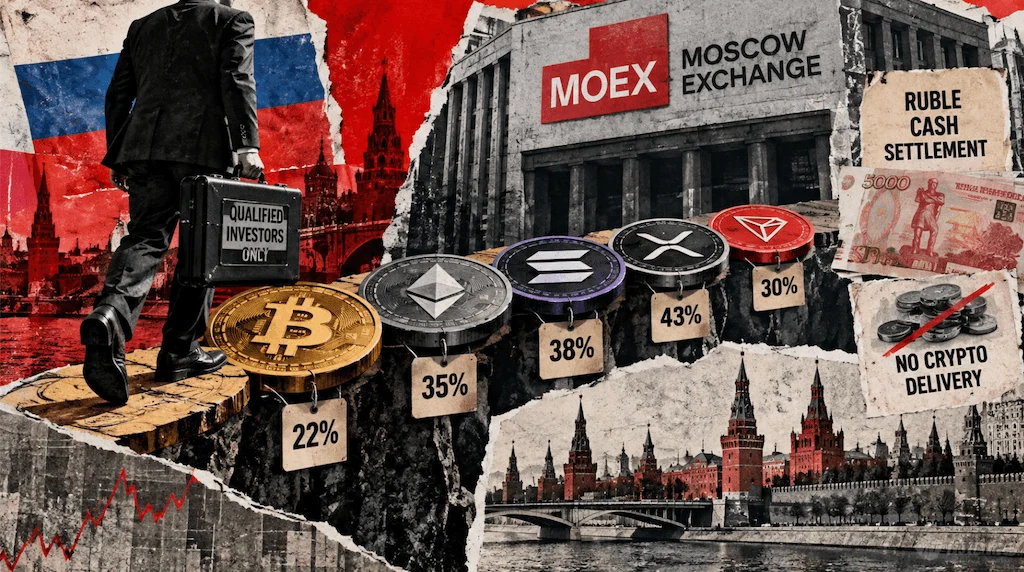

Beginning Sept. 22, the Moscow Exchange is introducing perpetual futures linked to five prominent cryptocurrencies, providing qualified investors with round-the-clock price tracking for Bitcoin, Ethereum, Solana, XRP, and Tron without the necessity of holding the underlying digital assets.
Identified as BTCUSDF, ETHUSDF, SOLUSDF, XRPUSDF, and TRXUSDF, these new instruments each follow a designated MOEX crypto index. They roll over automatically each day, enabling market participants to preserve their positions seamlessly without having to manually transition to a fresh contract upon expiration.
In contrast to spot cryptocurrency trading, these futures involve zero delivery of actual crypto. Their quotations rely on US dollar-denominated indexes, while all gains and losses settle in Russian rubles.
Exposure without ownership
This structural design enables investors to capture price fluctuations in cryptocurrencies without personally possessing Bitcoin, Ether, or alternative tokens.
MOEX specifies that access remains restricted to qualified investors. Consequently, these offerings broaden the exchange’s current derivatives portfolio rather than introducing spot crypto trading to everyday retail participants.
Furthermore, participants must supply collateral to engage in these trades. MOEX established first-tier minimum margin requirements at 22% for Bitcoin, 35% for Ether, 38% for Solana, 43% for Tron, and 30% for Tron—wait, excuse me, 43% for XRP and 30% for Tron. Under these rules, traders must put up a specific share of a position’s value as collateral, with XRP demanding the highest initial margin baseline among the quintet of contracts.
Additionally, MOEX has put concentration limits in place for every individual contract. Its LK1 and LK2 thresholds span from 961 and 4,807 contracts for XRPUSDF up to 124,490 and 622,450 for ETHUSDF.
Because these contracts possess varying specifications and values, those numbers cannot serve as direct comparative metrics for overall market exposure. Individual qualified clients will also receive their final trading terms directly through brokers.
This rollout expands upon the Moscow Exchange’s existing footprint in crypto derivatives. Having previously introduced dated futures tied to crypto indexes, the exchange reported on Sept. 16 that upwards of 72,000 qualified investors had participated in those digital-asset futures.
The exchange notes that cumulative turnover for those preceding products has surpassed 600 billion rubles.
These fresh perpetual options eliminate the requirement to manually shift positions into future-dated contracts. Because every contract spans a single day and transitions automatically into the subsequent trading cycle, investors enjoy uninterrupted exposure.
MOEX established the funding parameters with K1 at 0% and K2 at 0.35%.
Despite their perpetual nature, these offerings remain cash-settled derivatives. Investors tap into cryptocurrency price movements via a regulated MOEX instrument without ever taking delivery of or maintaining custody over the underlying digital coins.
Frequently Asked Questions
When will the new perpetual futures launch on the Moscow Exchange?
The Moscow Exchange is launching the perpetual futures on Sept. 22.
Which cryptocurrencies do the new contracts track?
The contracts track Bitcoin (BTCUSDF), Ethereum (ETHUSDF), Solana (SOLUSDF), XRP (XRPUSDF), and Tron (TRXUSDF).
Who is allowed to trade these perpetual futures?
Access is restricted exclusively to qualified investors.
How are profits, losses, and settlements handled?
The contracts are quoted against US dollar-denominated indexes, but all profits and losses are settled in Russian rubles without delivering any actual cryptocurrency.
What is the minimum margin requirement for XRP?
XRP carries the highest initial margin requirement among the five contracts, set at a first-tier minimum margin rate of 43%.