Solana sandwich bots took $29.7 million before costs, mostly targeting Pump.fun

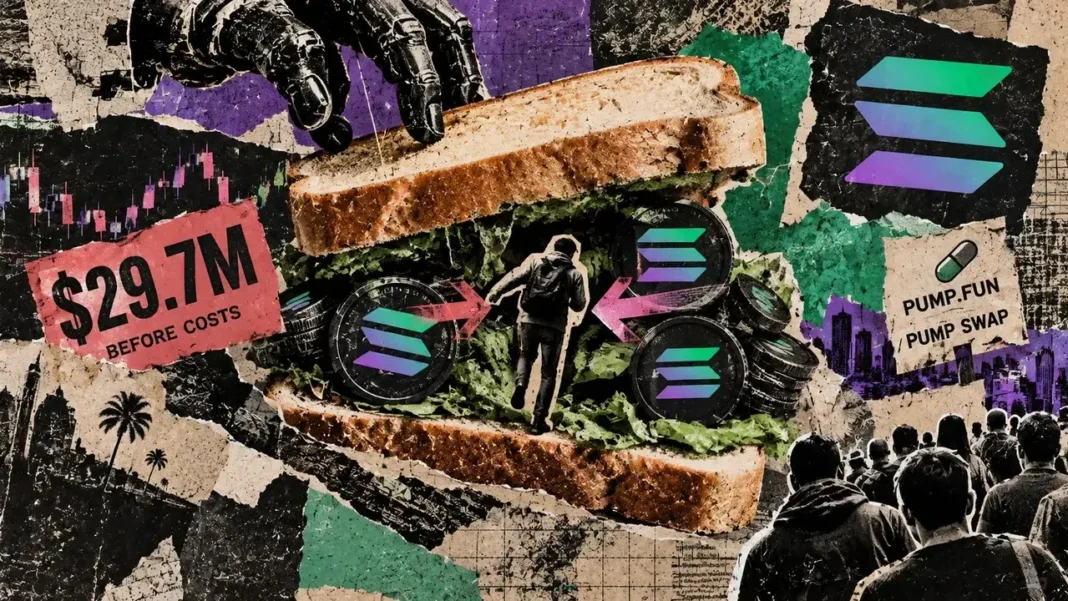
Over an 11-month span, sandwich bots pulled roughly $29.7 million in gross value from Solana trades, according to data from blockchain analytics provider Bitquery. The research revealed that 96% of the identified attacks targeted Pump.fun’s launch curve and its PumpSwap exchange.

Analyzing successful swaps between October 30, 2025, and October 7, 2026, the study documented 6,850,144 attacks executed by 2,545 bot wallets, impacting 2,154,994 unique wallets. These addresses do not equate to individual people, as trades originating from other bots made up 39% of the estimated gross earnings.

A sandwich attack occurs when a bot places a buy order and a sell order directly around another user’s swap. The initial purchase drives up the price in the liquidity pool, forcing the intervening buyer to acquire fewer tokens, after which the bot liquidates its holdings at the elevated price. The financial impact is absorbed by the trader during execution, even when the swap finishes successfully.

Related Reading

A tiny cluster of Solana bots unlocked a 3x trading advantage by routing through one proprietary protocol

Wide slippage marked greater exposure

Bitquery discovered that among swaps routed through Jupiter onto Pump.fun’s launch curve or PumpSwap, transactions permitting a 20% to 50% slippage tolerance were sandwiched 14 times more frequently than those capped below 3%.

Slippage tolerance defines the maximum permissible variance between an expected quote and actual execution. Documentation from Jupiter explains that this parameter establishes a minimum acceptable output once the tolerance is applied. If price movements exceed this threshold, the swap fails, whereas a wider limit allows for an unfavorable fill. This creates a compromise between successfully executing a volatile transaction and accepting a poorer price along the way.

The observed frequency of attacks did not scale uniformly with every broader setting. Tolerances set below 0.5% experienced more attacks than the 1% to 3% bracket, while the band of 50% or higher was targeted less frequently than the 20% to 50% range.

This slippage comparison is observational and focuses strictly on Jupiter routes that utilized Pump.fun’s launch curve or PumpSwap. Furthermore, Jupiter accounted for only a minor fraction of all victimized trades included in the study.

Related Reading

Solana’s 300ms speed boost to outrun trading bots might come with a hidden cost

The $29.7 million figure calculates SOL values at the precise minute of each attack and does not reflect net profit. In a separate fee sample of 63 attacks analyzed by Bitquery, bots kept 68% of total gross proceeds, while 18 attacks resulted in a net loss after accounting for expenses. That sample does not determine net earnings for the entire period. Additionally, the report notes discrepancies in how Pump.fun sale fees were recorded, which alters the gross estimate by roughly 3%.

To identify the bots, Bitquery relied on recurring trading behaviors, omitted round trips that commenced within a token’s first 10 slots, and noted occasional gaps in exchange and block data coverage. On-chain records cannot definitively prove that a bot viewed an order beforehand, meaning certain qualifying wallets might simply belong to fast traders.

Related Reading

Solana DEX volume spike hides circular trades, and automated bots are blamed

While slippage limits govern the price a trader is willing to accept, a separate research preprint submitted on September 23, 2026, investigated protected order flow—transactions intended to avoid front-running—across six blockchains. The authors documented sandwich patterns spanning multiple trades and blocks, leading them to conclude that these protective measures may provide weaker safeguards than users anticipate.

Frequently Asked Questions

How much money did Solana sandwich bots extract?

Sandwich bots extracted about $29.7 million in gross value from Solana trades over an 11-month period, according to data from Bitquery.

Which platform was targeted the most by these bots?

The vast majority of detected attacks—96%—targeted the memecoin platform Pump.fun’s launch curve and its PumpSwap exchange.

Did wider slippage settings increase the risk of an attack?

Yes, trades allowing 20% to 50% slippage were sandwiched 14 times as often as those allowing less than 3%, though attack rates did not rise uniformly across every wider setting.

Does the $29.7 million figure represent net profit for the bots?

No, the estimate values SOL at the exact minute of each attack and does not measure net profit. A smaller sample indicated that bots retained 68% of gross proceeds after fees, with some individual attacks losing money.


Hot this week

Some Kraken futures limit orders can still fill after a successful cancel

Kraken warns that certain futures limit orders may still execute following a successful cancellation if the request is processed during the Maker Protection hold window, converting the order into an immediate-or-cancel status.

Bitcoin hedge funds face a liquidation trap when their collateral is split across markets

Bitcoin hedge funds face liquidation traps when collateral is split across isolated markets. Even profitable market-neutral strategies can fail during downturns when exchanges cannot access offsetting gains elsewhere.

Tokenized stocks can carry the same rights without the same trading protections

Tokenized stocks under a new SEC exemption offer equivalent shareholder rights but operate outside key Regulation NMS protections, prompting firms like Douro Labs to seek clear standards for external price feeds and market data.

What happens when crypto trades stocks while Wall Street sleeps?

Crypto infrastructure enables 24/7 trading of traditional equity derivatives, allowing investors to make leveraged wagers on American semiconductor companies after Wall Street closes using extended-hours indices and perpetual futures.

Ethereum open interest rose 2.3% in ETH on Binance as its dollar value fell 6.6%

Ethereum open interest on Binance rose in coin quantity while dropping in dollar value. Tracking ETH units alongside USDT value separates actual futures exposure shifts from asset price repricing during market movements.

Topics

Some Kraken futures limit orders can still fill after a successful cancel

Kraken warns that certain futures limit orders may still execute following a successful cancellation if the request is processed during the Maker Protection hold window, converting the order into an immediate-or-cancel status.

Bitcoin hedge funds face a liquidation trap when their collateral is split across markets

Bitcoin hedge funds face liquidation traps when collateral is split across isolated markets. Even profitable market-neutral strategies can fail during downturns when exchanges cannot access offsetting gains elsewhere.

Tokenized stocks can carry the same rights without the same trading protections

Tokenized stocks under a new SEC exemption offer equivalent shareholder rights but operate outside key Regulation NMS protections, prompting firms like Douro Labs to seek clear standards for external price feeds and market data.

What happens when crypto trades stocks while Wall Street sleeps?

Crypto infrastructure enables 24/7 trading of traditional equity derivatives, allowing investors to make leveraged wagers on American semiconductor companies after Wall Street closes using extended-hours indices and perpetual futures.

Ethereum open interest rose 2.3% in ETH on Binance as its dollar value fell 6.6%

Ethereum open interest on Binance rose in coin quantity while dropping in dollar value. Tracking ETH units alongside USDT value separates actual futures exposure shifts from asset price repricing during market movements.

Backing Polymarket’s primary favorites would have lost 4%, new audit finds.

A new Bitquery audit reveals that backing every favorite candidate on prediction market Polymarket during 2026 US primaries would have resulted in a 4 percent loss, despite an 87 percent win rate.

Coinbase streams $150,000 Singapore trading cup and crowns its first champion

The exchange paired walkouts and memes with a ten-trader tournament; its displayed leaderboard listed Intern first without confirming a winner. The post Coinbase streams $150,000 Singapore trading cup and crowns its first champion appeared first on CryptoSlate.

Coinbase rolls out 10x spot leverage, but blocks US retail from it

Coinbase announced a new spot borrowing feature offering up to 10x leverage, but US retail investors are barred unless they meet strict Eligible Contract Participant financial thresholds.
spot_img

Related Articles

Popular Categories

spot_imgspot_img