

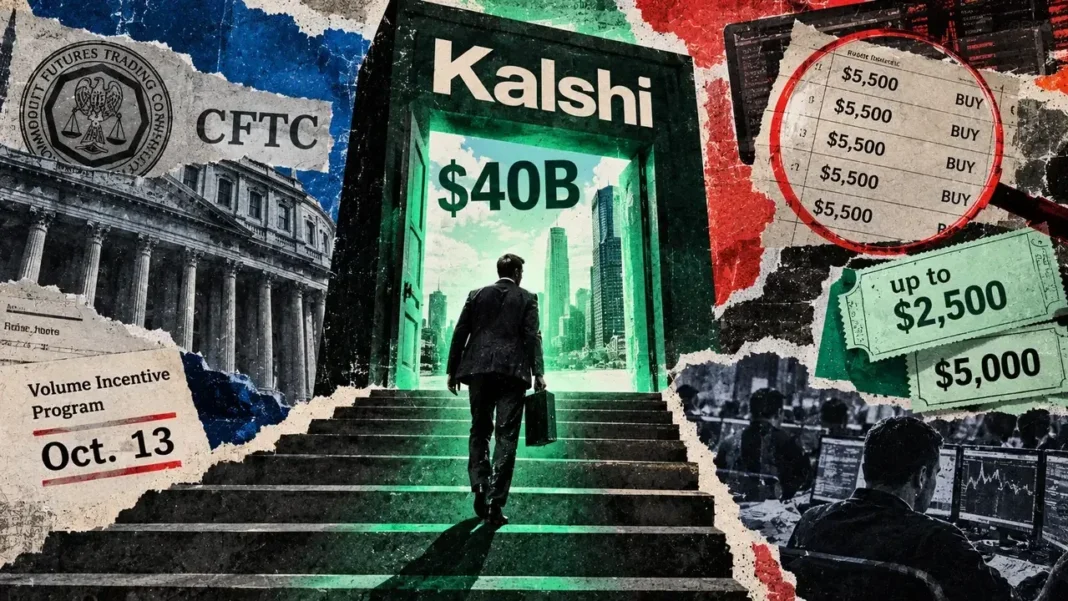

Prediction-market operator Kalshi is wrapping up a trader-volume incentive program almost a year ahead of schedule amid heightened scrutiny regarding activity within its crypto markets.
According to a filing dated Sept. 28, the company informed the Commodity Futures Trading Commission (CFTC) that its Volume Incentive Program will conclude no sooner than Oct. 13. This marks a sharp acceleration from the original end date of Oct. 1, 2027.
This move follows questions raised about trading patterns observed in Kalshi’s perpetual futures markets. Researchers pointed out repetitive transactions involving fixed dollar amounts—such as roughly $5,500 in Ethereum perpetuals—prompting reported examination by the CFTC.
While rejecting accusations of wash trading and stating it is not under investigation, Kalshi explained that the recurring transactions stemmed from market makers posting fixed-size quotes that other participants continuously hit.
The regulatory filing does not attribute the early cancellation to these inquiries or provide specific reasons for terminating the program prematurely, though the exchange retained the discretion to end it under the original terms.
Originally designed to boost liquidity on Kalshi’s central limit order book, the program let the platform pick eligible markets and set fixed reward pools. Participants earned a share proportional to their eligible volume, with event-contract payouts capped at half a cent per contract. Perpetual futures also qualified, remaining exempt from the normal qualifying price range of 3 cents to 97 cents.
That setup is now making way for a more versatile system that grants Kalshi greater freedom in allocating funds to attract and keep traders.
Kalshi shifts toward targeted trader rewards
Just days before the filing to sunset the volume program, Kalshi submitted a new Deposit and Trading Reward Incentive Program to the CFTC. A modified version was logged by the regulator on Sept. 25, with an earliest effective date of Sept. 28.
Although the two systems can temporarily overlap before the older one expires, they are not officially designated as direct replacements. Instead, the updated framework alters how incentives are distributed.
Rather than sharing out a fixed pool based on volume proportions, Kalshi can roll out time-limited promotions linked to deposits, trading activity, or both. These initiatives can last from three to 90 days and focus on specific groups based on metrics like account age, funding status, past activity, periods of inactivity, geographic location, and previous engagement with particular contract types.
Individual promotions can grant up to $2,500 per user, with an overall cap of $5,000 per person throughout the program’s intended two-year lifespan. Kalshi is permitted to deploy percentage matches or fixed-value incentives across sectors including crypto, sports, economics, financials, politics, weather, and entertainment.
Furthermore, the filing incorporates stricter definitions regarding abusive trading. Any transactions flagged for potential self-matching, wash trading, prearranged trades, or other banned behaviors will be barred from receiving promotional rewards.
Kalshi noted that its surveillance team will apply heightened supervision to participants collecting incentives, retaining the power to revoke eligibility or take disciplinary measures.
This provides Kalshi with a more precise customer-acquisition instrument at a time when the underlying economics and quality of trading volumes on prediction platforms face intense examination.
Record trading supports a $40 billion pitch
This incentive overhaul occurs even as Kalshi continues to post record headline volume figures.
The exchange broke multiple trading records throughout September. Figures gathered by DeFiRate reveal that Kalshi processed a record $3.24 billion on Sept. 27, while weekly volume hit $15.66 billion for the seven-day period ending that day. Its portion of tracked prediction-market volume hovered near 80%, marking a sharp increase compared to the previous year.
This rapid expansion is increasingly reflected in the valuation investors are willing to assign to the business.
People familiar with the negotiations told Reuters that Kalshi is engaged in advanced talks to secure roughly $1 billion in funding at a valuation close to $40 billion. Sequoia Capital and Wellington Management are reportedly discussing leading the round, alongside potential investments from Tiger Global and Dragoneer Investment Group.
Achieving a deal at that level would nearly double the $22 billion valuation Kalshi attained during a $1 billion funding round in May. Reuters added that the enterprise is also looking into expanding beyond prediction markets into alternative asset classes and has held preliminary talks regarding a prospective initial public offering.
Consequently, the transition in incentive structures carries implications that stretch past the rewards themselves. As Kalshi targets a valuation comparable to traditional financial-market operators, investors must evaluate how much of its surging activity stems from organic customer demand versus exchange-stimulated economics.
Frequently Asked Questions
-
Why is Kalshi ending its Volume Incentive Program early?
Kalshi is terminating the program no earlier than Oct. 13—nearly a year ahead of its scheduled 2027 end date—as it transitions to a broader, more flexible framework for targeted trader rewards. The filing does not explicitly link the early end to recent scrutiny of crypto trading patterns. -
Is Kalshi under investigation by the CFTC?
Kalshi has stated that it is not under investigation and has denied allegations of wash trading, attributing repetitive transactions in its perpetual futures markets to market makers placing fixed-size quotes that other traders repeatedly hit. -
How does the new Deposit and Trading Reward Incentive Program work?
The new framework allows Kalshi to run time-limited promotions lasting from three to 90 days tied to deposits and trading activity. It targets specific user groups based on account age, activity, and location, offering individual payouts of up to $2,500 per participant with a $5,000 lifetime cap. -
What are Kalshi’s current valuation and fundraising targets?
Kalshi is in advanced discussions to raise about $1 billion at a valuation of roughly $40 billion, which would nearly double the $22 billion valuation it achieved in May.