

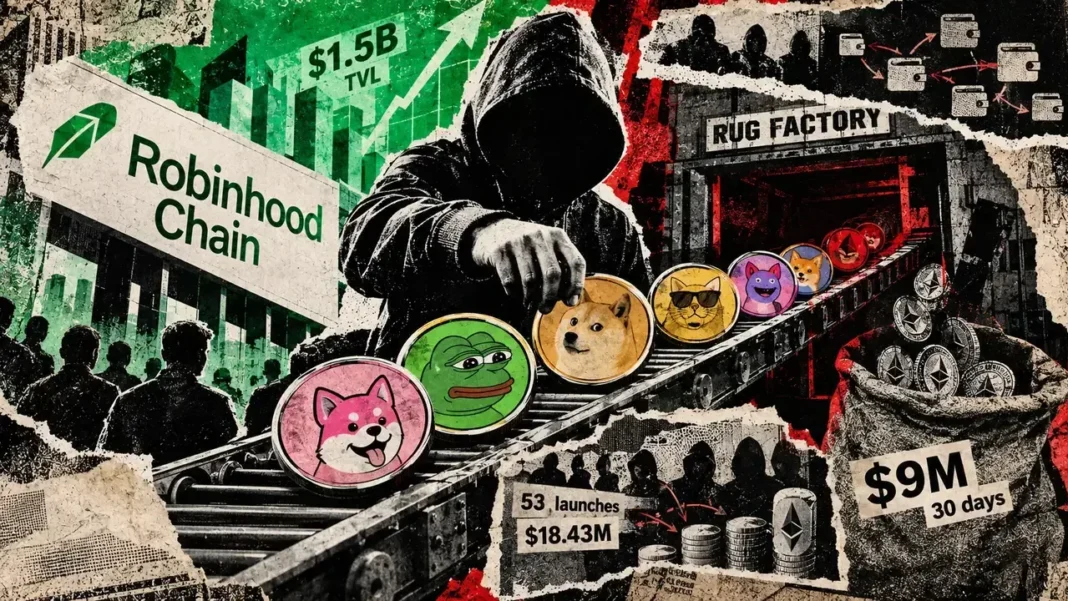

A second suspected memecoin rug factory has emerged on Robinhood Chain, highlighting an increase in coordinated scam activity as the network experiences rapid growth.
Blockchain security firm GoPlus reported on Sept. 28 that it uncovered a high-risk operation linked to hundreds of memecoins. The scheme funneled more than $9 million through a shared fund-consolidation network during the preceding 30 days.
According to GoPlus, the operation deployed batches of newly created wallets to buy and sell tokens before pooling the revenue into related addresses. As of Sept. 28, its primary consolidation wallet tracked approximately 3,589 ETH—valued at about $9.49 million—in two-way flows across its most recent 400 transactions.
GoPlus clarified that this metric measures gross flows rather than net profits or actual investor losses. Nevertheless, the security firm emphasized that the wallet behavior revealed a repeatable pattern where the profits from one set of token releases helped fund the next.
Under this approach, operators launched tokens centered on popular trends, split the token supply among freshly generated wallets possessing minimal transaction histories, and executed sales through contracts such as PonsV2Helper and UniversalRouter. The ETH gathered from these sales traveled via local sweep wallets before landing in the broader consolidation pool.
Such a framework obscures the actual amount of a token controlled by a single entity. Rather than one address executing a large dump, dozens of seemingly independent accounts sell progressively, mimicking organic market activity before gathering the funds elsewhere.
GoPlus stated that this setup differs from a classic rug pull, which typically involves sudden liquidity removal or trading restrictions preventing users from selling. Instead, the firm’s primary concern centers on the coordinated ownership, exit strategies across ostensibly unconnected wallets, and the reinvestment of earnings into subsequent token generation.
Earlier operation extracted $18.4 million from 53 launches
These findings follow an earlier discovery by on-chain analyst Wazz, who flagged a separate suspected serial-rug operation on Robinhood Chain. That initiative allegedly drained approximately $18.43 million across at least 53 memecoin launches over a roughly two-month span.
That particular ring utilized a variation of the same core strategy. Groups ranging from 70 to 200 wallets bought up major portions of token supplies shortly after debut, frequently leaving the cluster in control of over 70% of a given token.
Wazz also uncovered connections between consecutive launches, noting that capital from one project flowed directly into wallets designated to fund another. This indicated that earnings were recycled instead of cashed out following individual trades.
GoPlus noted that both operations share notable traits, including heavy reliance on Pons V2 infrastructure, large batches of wallets designed to mask supply concentration, and the transfer of capital from one token deployment to the next.
At the same time, the security firm warned there is no proof tying the two clusters to the same individuals. While the newer scheme leans heavily on fresh wallets paired with subsequent consolidation, the group identified by Wazz employed larger clusters positioned to seize supply control immediately upon launch.
This distinction implies that the fraudulent activity spans beyond a single group. Similar financial structures can be replicated utilizing different wallet frameworks, granting bad actors multiple paths to make coordinated sell-offs appear as normal trading volume.
Consequently, wallets, launchpads, and trading interfaces face a much more complex detection challenge. Catching malicious code alone is insufficient to flag a token if its smart contracts operate normally while its supply remains quietly concentrated among dozens of interconnected addresses.
Robinhood Chain’s rapid growth raises the stakes
These suspected factories are appearing alongside the unprecedented expansion of Robinhood Chain.
Launched on July 1, the Ethereum layer-2 network surpassed $1.5 billion in total value locked as of press time, according to DeFiLlama data. Achieving this milestone in under 90 days highlights the network’s rapid adoption.
Token Terminal figures indicate that Robinhood Chain has produced approximately $50 million in revenue during its roughly three-month existence, reflecting the heavy trading volume already active on the chain.
Robinhood’s broader business opportunity goes beyond fees collected from crypto-native participants. The brokerage boasts 28.6 million funded accounts and roughly $384 billion in assets, presenting developers with the potential to build on-chain offerings that may eventually tap into a massive mainstream financial customer base.
That widespread distribution capacity also increases the stakes for failing to intercept fraudulent token launches early on.
Although a permissionless network allows external developers to deploy products without requiring Robinhood to clear every smart contract, the applications and interfaces users interact with can still incorporate screening mechanisms, wallet alerts, and concentration analysis.
The emergence of a second suspected rug factory makes these protective measures even more critical before Robinhood exposes a wider portion of its brokerage clientele to on-chain ecosystems.
Ultimately, the business challenge for Robinhood lies in maintaining the open environment driving its network’s growth while stopping organized token operators from exploiting that exact distribution network to target a much larger pool of retail funds.
Frequently Asked Questions
What is a memecoin rug factory on Robinhood Chain?
It is a coordinated operation that repeatedly launches multiple memecoins using fresh batches of wallets to mask supply concentration, sell tokens, and recycle the proceeds into subsequent token releases.
How much money has been tied to these operations?
Blockchain security firm GoPlus identified an operation routing more than $9 million over 30 days, with a primary consolidation wallet handling roughly $9.49 million in two-way flows. An earlier operation flagged by researcher Wazz allegedly extracted about $18.43 million across 53 launches.
How fast has Robinhood Chain grown?
Launched on July 1, the Ethereum layer-2 network reached over $1.5 billion in total value locked in less than 90 days, generating approximately $50 million in revenue during its first three months, per DeFiLlama and Token Terminal data.
Are these operations traditional rug pulls?
GoPlus noted they do not match traditional rug pulls where liquidity suddenly disappears or trading is blocked. Instead, the risk comes from coordinated ownership and exit strategies across separate-looking wallets that recycle funds into future token launches.