



Bitcoin’s newly confirmed bull market is already exhibiting signals that its upward momentum might be fading.
Recently, the leading digital asset reached an eight-month peak close to $87,400 after breaking through a long-term technical level that CryptoQuant identified as the beginning of a new bullish cycle. Since then, the Bitcoin Bull Score Index has climbed to 90 out of 100, reflecting generally positive market conditions.
Additionally, figures from Look Into Bitcoin indicate that “Bitcoin sentiment has hit its greediest reading since July 2025.”
However, behind this headline strength, the balance between fresh demand and existing investors looking to cash out is starting to shift.
This shift does not yet signal a collapse of the broader trend. Bitcoin continues to hold above several long-term support levels and has kept much of its recent gains. Even so, softening demand and heavier profit-taking suggest the market could soon experience its initial significant test since the breakout.
Demand fades as spot buying weakens and holders take profits
The most evident pressure is appearing across the primary demand drivers that supported Bitcoin’s climb.
CryptoQuant estimates that apparent spot demand shrank by roughly 170,000 BTC over the prior 30 days, pointing to cash-market purchases failing to keep pace with the upward price movement.
Inflows into US exchange-traded funds reflect a similar trend. CryptoSlate previously reported that daily ETF inflows dropped by 97% over the course of a week, sliding from roughly $1 billion down to just $31 million by Sept. 28.
Speculative interest has cooled even more rapidly.
CryptoQuant estimates that growth in futures demand dropped from 164,000 BTC on Sept. 14 to about 16,000 BTC, removing another incremental source of buying pressure as Bitcoin pulls back from $87,400.
This slowdown carries greater weight because current holders are sitting on significantly larger profits.
Unrealized profit margins for short-term traders have risen to 33%, the highest level since December 2024, expanding the pool of gains available to be locked in if investors choose to trim their holdings.
Some participants have already done so.
According to CryptoQuant, Bitcoin holders locked in profits on 25,700 BTC on Sept. 22—marking the largest single-day total of 2026—as investors leveraged the rally to secure profits near the top of the recent price band.
As a result, Bitcoin faces a widening imbalance: the pace of fresh acquisitions has slowed while the volume of profitable coins available for liquidation has grown.
This dynamic does not signify a cycle top. Nevertheless, another sustained push higher would likely demand an increase in spot buying sufficient to absorb profit-taking from investors who originally acquired Bitcoin at lower price points.
Futures take control as liquidation risk flips to Bitcoin longs
Bitcoin’s market mechanics have grown increasingly reliant on derivatives, even as aggregate leverage pulls back.
CryptoQuant metrics indicate that the spot-to-futures volume ratio on Binance sits near 0.12, implying that roughly 90% of total trading volume occurs within futures. For every dollar exchanged on the spot market, approximately $8 to $9 changes hands through derivatives.
Despite declining leverage, this disparity has barely improved because cash-market participation stays muted.
Open interest on Binance decreased from $10.6 billion to roughly $9.2 billion over the past week. Data from Glassnode indicates a broader contraction, showing that coin-denominated open interest for BTC dropped by nearly 20% to reach its lowest mark since March, despite the recent price gains.
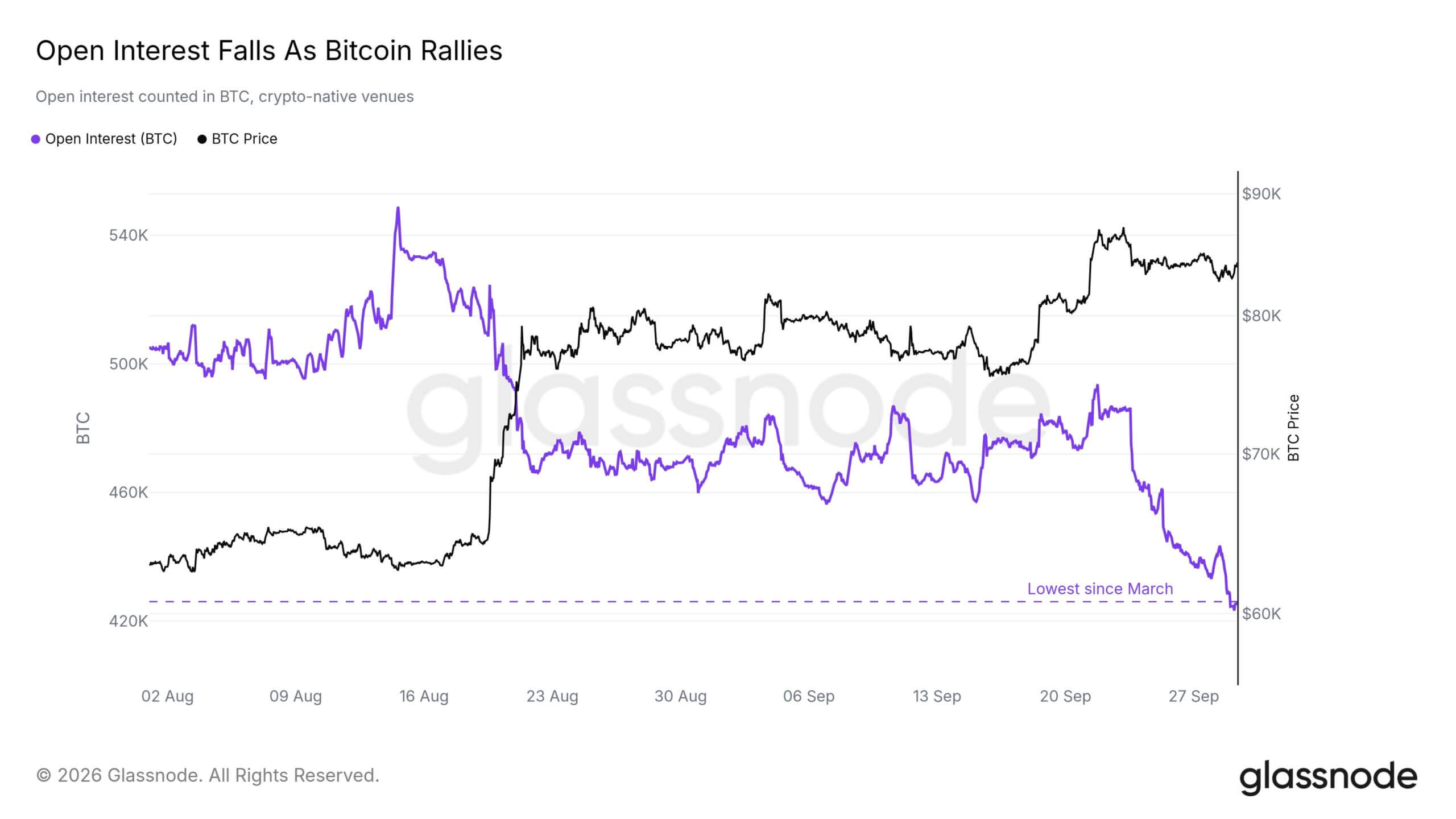
This contraction works in both directions. Reduced leverage lowers the amount of speculative backing available to fuel another swift advance, but it also leaves the market less exposed to crowded positioning that can intensify liquidations.
Even so, the composition of the remaining leverage is becoming increasingly critical.
Figures from Alphractal reveal that Bitcoin’s advance toward $87,000 cleared out the largest clusters of short positions built up over the previous 365 days. The price action encompassed what the analytics platform categorized as the year’s largest short-liquidation pool, driving bearish traders out of their positions as prices accelerated upward.
Those liquidations fueled the advance because short sellers were forced to repurchase their positions as Bitcoin climbed.
That driver of forced buying has now been largely exhausted.
Alphractal reported that the largest unliquidated position clusters are presently concentrated among long positions, altering the market’s liquidation exposure in the wake of the recent short squeeze.
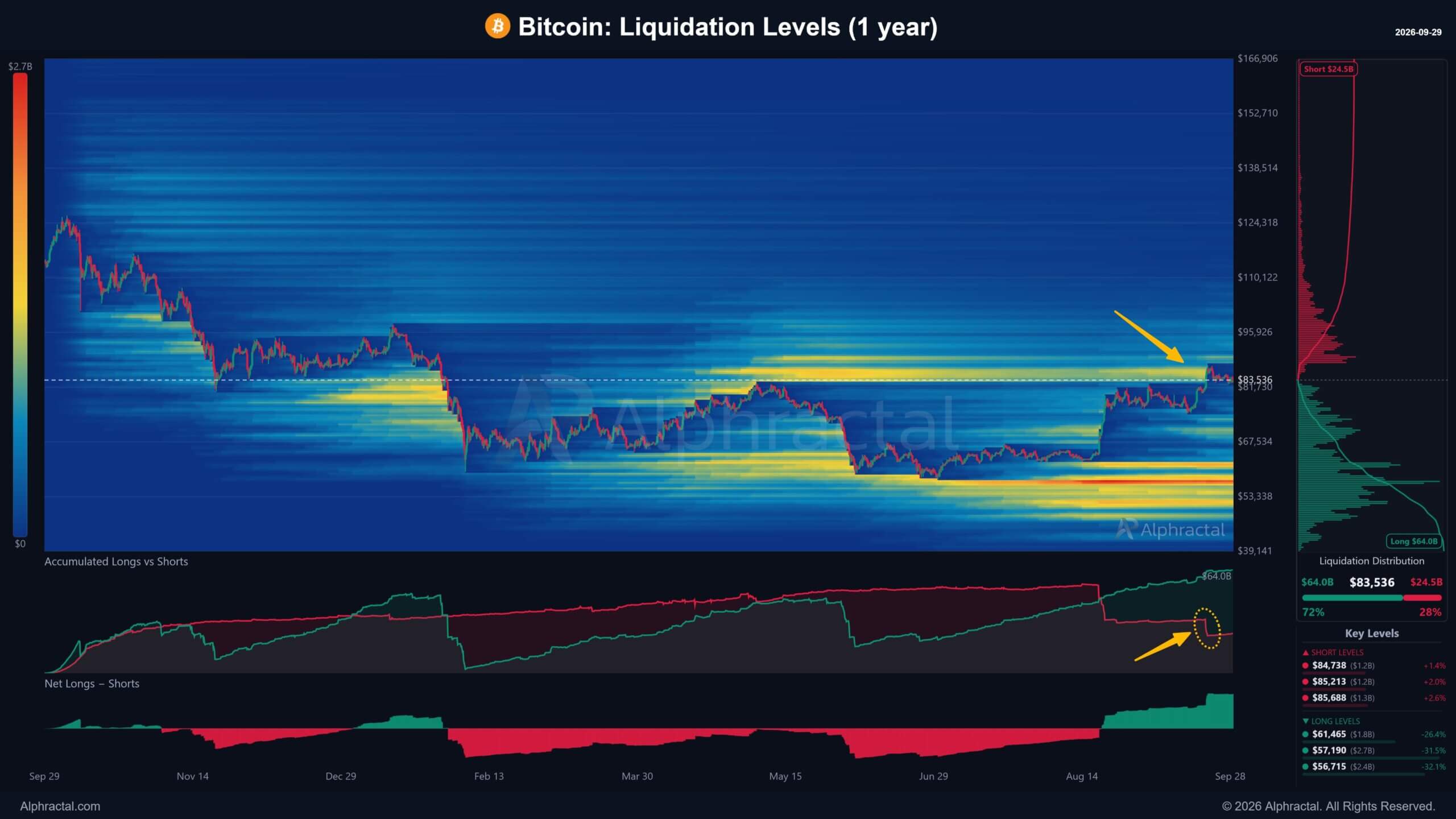
Consequently, fewer sizable short positions remain to supply forced purchasing if Bitcoin climbs again. Conversely, a price drop could begin impacting concentrated long positions, transforming leveraged traders into a catalyst for forced selling.
Major investors have also yet to demonstrate sustained bullish commitment.
Joao Wedson, CEO of Alphractal, noted that the firm’s Whales vs. Retail Delta metric recently indicated whales growing more bullish relative to smaller market participants, though this trend failed to endure. He emphasized that the indicator must turn positive and stay there to offer clearer proof that larger investors are positioning for a lasting extension of the rally.
This shift in positioning places greater importance on Bitcoin’s downside support levels if momentum continues to wane.
The 365-day moving average hovers near $80,000, the threshold Bitcoin reclaimed when CryptoQuant signaled the beginning of the new bull phase. Further down, the 200-day moving average rests around $71,000, while the realized price for traders is near $67,000.
A correction toward $80,000 would offer the initial test of how effectively the breakout can endure the changing dynamics of demand and positioning. Breaking below that threshold would expose deeper support levels while raising the probability that the long positions left behind following the short squeeze turn into the next catalyst for forced liquidations.
Frequently Asked Questions
-
What triggered Bitcoin’s recent rally to nearly $87,400?
Bitcoin climbed to an eight-month high after reclaiming a long-term technical threshold that CryptoQuant identified as the start of a fresh bullish phase. -
How have US ETF inflows changed recently?
Daily ETF inflows dropped by 97% over a single week, falling from around $1 billion down to $31 million by Sept. 28. -
What is the current state of Bitcoin futures and derivatives?
Derivatives make up about 90% of combined trading activity on Binance, with open interest dropping to roughly $9.2 billion as overall leverage retreats. -
What are the key downside support levels to watch?
Key support levels include the 365-day moving average near $80,000, the 200-day moving average near $71,000, and traders’ realized price around $67,000.