



A widespread cryptocurrency selloff pushed Bitcoin to an intraday low near $80,000, setting off a liquidation cascade totaling more than $1 billion that overwhelmingly penalized traders betting on upward price movement.
At the time of publication, the leading cryptocurrency traded around $80,744, reflecting a 3% decrease over a 24-hour window and roughly a 4% drop across the past week. This downward movement extends the asset’s retreat from a recent push to recapture $87,000.
According to metrics from CoinGlass, the downturn resulted in $1.16 billion in liquidations across the derivatives sector within 24 hours. Bullish, or long, positions accounted for $1 billion of that figure, while short positions represented $108 million.
These metrics highlight how rapidly market positioning can sour when declining asset values compel exchanges to terminate leveraged positions that fail to satisfy collateral rules. Such liquidations often exacerbate downward price action as platforms dump holdings or close longs into an already softening market.
Selling pressure grew more severe over a short period, with CoinGlass tracking nearly $700 million in liquidations across a four-hour span, which included $650 million in long trades. Altogether, 166,769 individual traders experienced liquidations throughout the 24-hour cycle.
Ethereum leads the over $1 billion liquidation rout
Although Bitcoin’s retreat captured the bulk of market attention, Ethereum recorded the largest liquidation losses among primary digital assets.
CoinGlass data indicated that roughly $324 million in Ethereum positions were liquidated over 24 hours, compared to $240 million for Bitcoin.
Ethereum dropped beneath $2,500, marking a 4% loss over the same period and stretching its weekly drop to approximately 9.3%.
The single largest liquidation event took place on Hyperliquid, where an ETH-USD position valued at approximately $20 million was shut down.
These losses rippled across other top digital assets as the market unwound accumulated bullish leverage.
Solana dropped 7.2% over a 24-hour stretch to trade near $108.61, whereas XRP fell 5.7% to $1.35. BNB dropped 4.9%, and Zcash experienced one of the most severe drops among large-cap coins, plunging 14%.
The heavier drops seen in various altcoins signal that the wider crypto market is under greater distress than Bitcoin’s individual percentage drop indicates on its own.
This dynamic follows prior warnings noting that leverage throughout the altcoin sector had grown increasingly overextended.
In its weekly market update on Oct. 7, Glassnode pointed out that a rising portion of large-cap altcoins maintained unusually high open interest relative to their overall market capitalization.
The analytics provider noted that this ratio hit its highest point since the period leading up to the October 2025 crypto market correction.
Such positioning leaves traders susceptible to additional forced liquidations should values continue falling before they unwind their leveraged bets.
Bitcoin’s newest investors rush coins to exchanges
This market stress is likewise apparent in Bitcoin’s on-chain data, which shows a rising volume of newly acquired tokens heading toward exchanges.
Data from CryptoQuant reveals that short-term Bitcoin owners moved more than 50,000 BTC to exchanges during the peak of the 24-hour window.
Out of that volume, upwards of 29,500 BTC was deposited at a loss, accounting for roughly 59% of that demographic’s exchange inflows.
CryptoQuant stated that the losses tied to these transfers marked the highest figures logged among short-term investors in nearly four months.
This activity highlights a souring of sentiment among participants who secured Bitcoin fairly recently and tend to react more strongly to price fluctuations.
Substantial exchange deposits often point to an intent to sell, especially when participants transfer coins at a loss.
Nonetheless, these deposits do not guarantee immediate sales, although the surge in loss-driven deposits introduces an extra potential source of supply while leveraged positions are already being dismantled. This trend also contrasts with the profit-taking behavior observed during Bitcoin’s recent push past $85,000.
Glassnode previously noted that short-term investors accounted for about 86% of exchange inflows on Oct. 4 as Bitcoin settled above that threshold, representing the peak proportion in a year.
The transition from profit-taking to loss-driven transfers implies that the market pullback is increasingly impacting participants who entered positions during the latest upward move.
Bitcoin’s $81,000 buy wall faces a crucial test
The immediate question is whether Bitcoin can muster enough buying interest near $81,000 to absorb the mounting selling pressure.
In its Oct. 7 report, Glassnode highlighted a heavy concentration of resting purchase orders spanning $81,000 and $81,250 on the Binance spot order book.
These orders had built up starting Oct. 3, forming the biggest visible cluster of bids below the current price of Bitcoin.
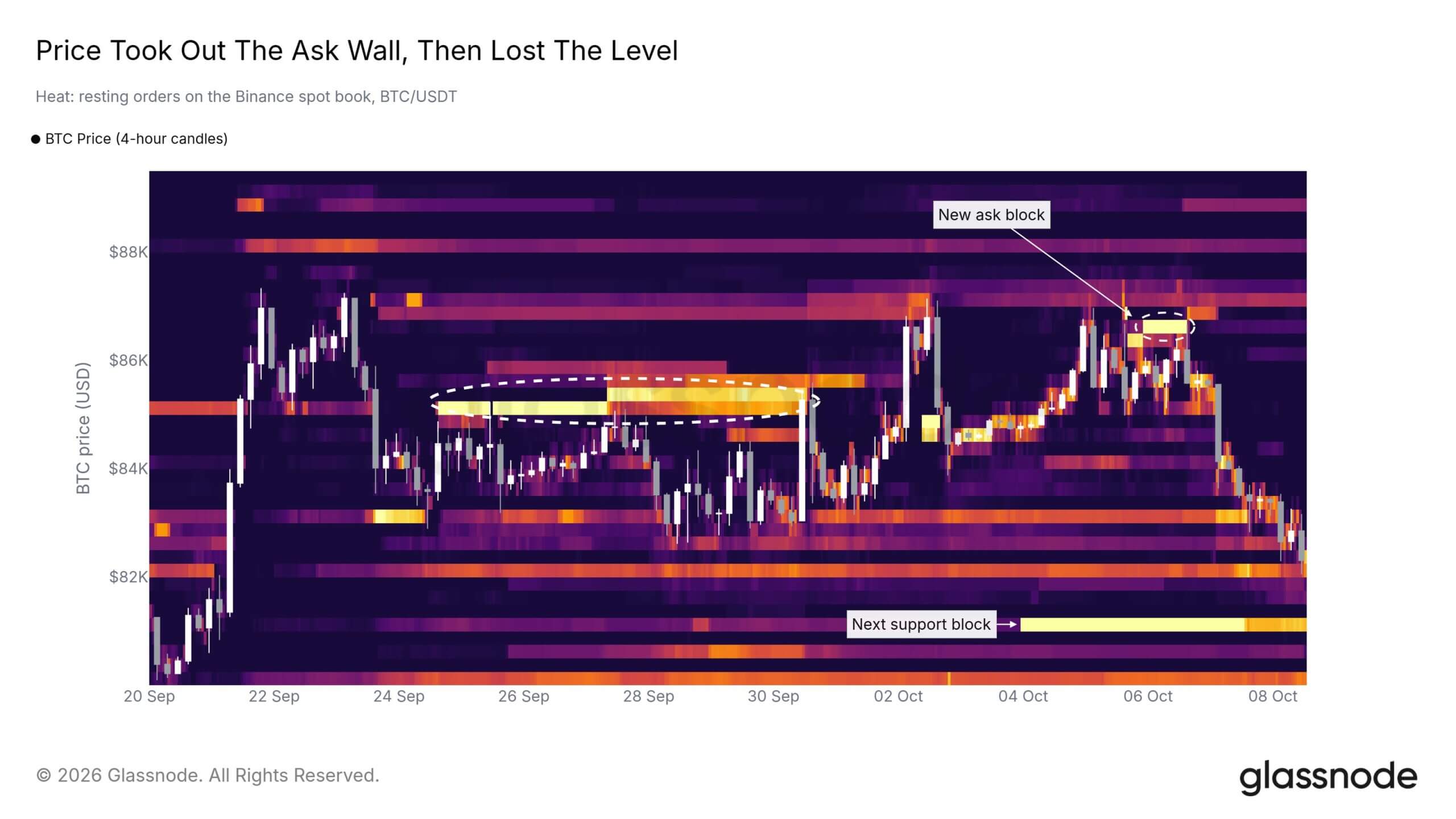
The firm designated this region as a critical support level after Bitcoin failed to break through sell orders situated between $86,500 and $86,750, subsequently losing the support that had formed around $85,000.
However, heavy bid concentrations do not ensure price stability, as orders can be canceled and persistent selling can overwhelm existing demand.
Glassnode’s derivatives review flagged a dense cluster of prospective liquidation points between $81,700 and $83,300, alongside another notable grouping close to $75,000.
The latest drop has already cut through a significant portion of that near-term zone, keeping traders focused on whether buying demand around $81,000 can hold up against further downside pressure.
A definitive drop beneath the $81,000 bid range could drag Bitcoin down further, potentially drawing focus toward the deeper liquidation clusters outlined by Glassnode.
FAQs
- How much were total crypto liquidations during the selloff?
- The market decline triggered $1.16 billion in liquidations across the derivatives market over a 24-hour period, with bullish long positions accounting for $1 billion of that total.
- Which cryptocurrency suffered the largest liquidation losses?
- Ethereum experienced the highest liquidation losses among major cryptocurrencies, with approximately $324 million in liquidated positions compared to $240 million for Bitcoin.
- What are short-term Bitcoin holders doing with their coins?
- Short-term Bitcoin holders transferred over 50,000 BTC to exchanges at the 24-hour peak, with more than 29,500 BTC of that total moved at a loss—the highest loss-associated transfer volume in nearly four months.
- Where is Bitcoin’s key support level currently located?
- Glassnode identified a substantial concentration of resting buy orders between $81,000 and $81,250 on Binance’s spot order book acting as the next major support block.