Bitcoin futures drop $1.4B, but spot buyers step in to help

Bitcoin’s aggregate futures exposure dropped as recently active capital gained a larger share through October 4. Because younger coin cohorts tend to spend more easily during market volatility, ongoing buying continues to test how effectively the market can absorb this active supply.

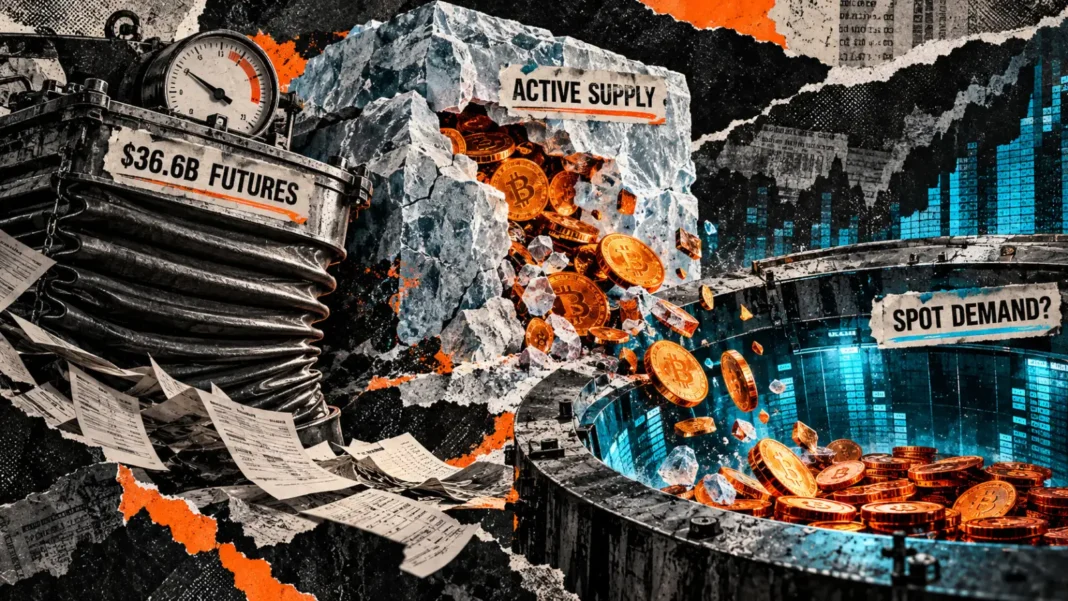
According to Glassnode’s October 5 Market Pulse, futures open interest fell from $38 billion down to $36.6 billion. Concurrently, Hot Capital Share climbed from 18.9% to 19.5%, and the ratio of short-term-to-long-term holder supply increased from 13.7% to 14.2%.

While open interest tracks outstanding futures exposure, evaluating the fragility of those positions also demands data regarding account leverage and collateral.

The remaining exposure stayed close to the upper boundary of Glassnode’s statistical range. Furthermore, long-side funding payments increased from $926,400 to $1.5 million, indicating that the reduction in open interest occurred alongside an intensified demand for bullish perpetual exposure.

How recent activity changes the risk picture

The glossary in Glassnode’s March 2025 Market Pulse defines Hot Capital Share using a three-month timeframe.

Additionally, its realized-cap age-band methodology values coins according to the price at which they last moved, dividing the value of each band by the total realized capitalization. This denominator reflects the combined last-movement value of the entire coin supply.

When older coins are transferred, their age resets and their realized value refreshes, meaning an established holder can reactivate dormant coins to boost the economic weight of recent coins. However, activity alone cannot pinpoint first-time investors or fresh fiat deposits.

The supply ratio is calculated by dividing the short-term-holder coin supply by the long-term-holder coin supply. At 14.2%, this signifies roughly 14.2 units of short-term supply for every 100 units of long-term supply.

Related Reading

Altcoin spot volume nears 4x Bitcoin’s as ETF inflows shrink across five sessions

Glassnode’s holder categorization sorts addresses into entities, smoothing their entity-average holding-age classification around a 155-day midpoint while omitting exchange balances.

Younger cohorts generally spend more freely during market fluctuations. Their expanding relative presence keeps price sensitivity high while leaving the exact timing and direction of future spending uncertain.

The report’s spot cumulative volume delta—which measures the difference between buyer- and seller-initiated trades—shifted from a negative $102.8 million to a positive $33.2 million. Because this metric tracks trading aggression, the improvement points to a pivot toward buyers, though it does not measure new investor capital.

Whether ongoing demand can absorb active supply serves as the upcoming test. Consistent spot buying would help alleviate fragility concerns, whereas renewed taker selling combined with worsening holder profitability would amplify them.

Consequently, futures exposure and holder activity must be evaluated in tandem. The October snapshot reveals a reduced nominal derivatives footprint alongside a greater share of recently active capital, balanced by improving spot buying. Holder sensitivity continues to be an independent risk factor worth monitoring.

Frequently Asked Questions

What happened to Bitcoin futures open interest according to the Glassnode report?

Futures open interest dropped from $38 billion down to $36.6 billion, even as long-side funding payments increased from $926,400 to $1.5 million.

What is the short-term-to-long-term holder supply ratio?

The ratio increased from 13.7% to 14.2%, meaning there are about 14.2 units of short-term supply for every 100 units of long-term supply.

How did spot trading activity shift during this period?

The spot cumulative volume delta transitioned from a negative $102.8 million to a positive $33.2 million, signaling a shift toward buyer-initiated trades.

Why are younger coin cohorts significant during volatility?

Younger coin cohorts tend to spend more readily during market fluctuations, meaning their growing relative presence maintains price sensitivity.


Hot this week

Anthropic hits $1.5 trillion valuation in record IPO as ECB warns AI funding could dry up

Anthropic priced its $81 billion IPO at $83 a share Wednesday. The company behind Claude said it expected trading to begin on Nasdaq on Nov. 19. If the stock opens above $83, investors who got shares in the offering will have an immediate gain on paper. Anthropic won't get any extra cash from that move.……

Biggest AI Event of the Year – Building Digital-First Future-Ready Oman in the Era of Enterprise Artificial Intelligence

Oman prepares for the sultanate’s most powerful AI gathering,...

The Trading Festival Mexico Day 2 Opens Following an Exciting First Day of Trading, Learning and Competition

Following an action-packed opening day, The Trading Festival Mexico...

Strategy’s STRC stock crashes to $95 despite promise of 44 years of dividends

Strategy's (formerly MicroStrategy) STRC preferred stock plunged to its lowest level since August on Wednesday despite the company's multibillion-dollar repurchase campaign. The Michael Saylor-led company's preferred shares fell to $95.51 before recovering to $96.16, according to Strategy's data. The decline left STRC roughly 4% below its $100 stated amount, pushing its annualized yield to approximately……

Bitcoin crashes near $62,000 over weekend as crypto liquidations topped $1.8 billion

Bitcoin plunged to a four-month low near $62,000 on Sunday, Nov. 15 as heavy selling in dollar-denominated markets intensified a broader cryptocurrency downturn. Bitcoin fell to about $62,000 on Nov. 15, its weakest level since July, before rebounding. Binance Research said the decline extended BTC's losses to 15.6% over 11 days, which is its sharpest……

Topics

Anthropic hits $1.5 trillion valuation in record IPO as ECB warns AI funding could dry up

Anthropic priced its $81 billion IPO at $83 a share Wednesday. The company behind Claude said it expected trading to begin on Nasdaq on Nov. 19. If the stock opens above $83, investors who got shares in the offering will have an immediate gain on paper. Anthropic won't get any extra cash from that move.……

Strategy’s STRC stock crashes to $95 despite promise of 44 years of dividends

Strategy's (formerly MicroStrategy) STRC preferred stock plunged to its lowest level since August on Wednesday despite the company's multibillion-dollar repurchase campaign. The Michael Saylor-led company's preferred shares fell to $95.51 before recovering to $96.16, according to Strategy's data. The decline left STRC roughly 4% below its $100 stated amount, pushing its annualized yield to approximately……

Bitcoin crashes near $62,000 over weekend as crypto liquidations topped $1.8 billion

Bitcoin plunged to a four-month low near $62,000 on Sunday, Nov. 15 as heavy selling in dollar-denominated markets intensified a broader cryptocurrency downturn. Bitcoin fell to about $62,000 on Nov. 15, its weakest level since July, before rebounding. Binance Research said the decline extended BTC's losses to 15.6% over 11 days, which is its sharpest……

Wall Street wants 24/7 trading, but somebody has to bankroll the weekend

As Wall Street shifts toward round-the-clock trading, financial firms face the critical challenge of managing liquidity and financial obligations when primary wholesale payment systems are shut down over the weekend.

Bitcoin and Ethereum sink to 3-month lows, but a bigger crypto selloff may be ahead

Bitcoin and Ethereum plummeted to three-month lows on Thursday, intensifying a severe cryptocurrency market downturn that has erased $550 billion in total valuation since October.

Zcash loses $1,000 as dormant wallets send ZEC coins to exchanges

Zcash fell below $1,000 as leveraged traders abandoned bullish positions and selling pressure intensified. Data from CoinMarketCap showed ZEC at approximately $965 on Nov. 12, after a 24-hour low near $953. The decline has exposed vulnerabilities in ZEC's market structure, with research showing heavy selling across derivatives exchanges and fresh deposits from previously inactive wallets.……
spot_img

Related Articles

Popular Categories

spot_imgspot_img