
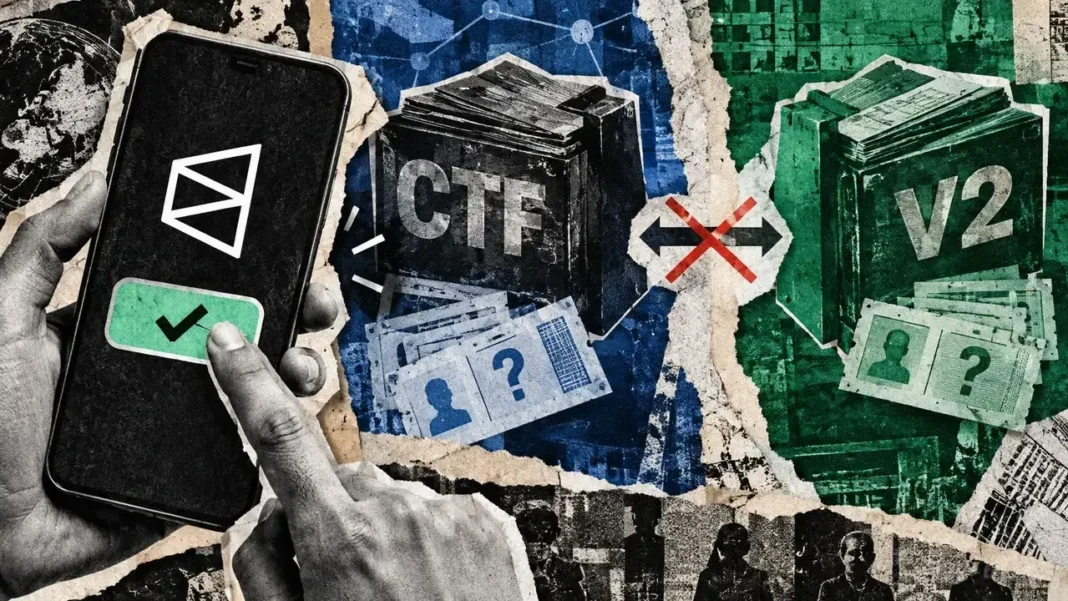

The introduction of Polymarket’s Protocol V2 does not automatically transfer existing wagers from the older Conditional Tokens Framework (CTF) to new contracts. According to migration guidance, trading integrations are instructed to maintain support for those existing holdings while simultaneously incorporating a separate architecture for V2 positions and fresh trading privileges.
Rajath Alex noted in an Oct. 5 announcement that Polymarket would run a series of live test markets—referred to as canary markets—between Oct. 5 and Oct. 30. He pointed to Nov. 2 as an anticipated launch date for newly generated markets, clarifying that it is not a hard deadline to convert every active bet.
End users accessing Polymarket through its official website or application do not need to perform any technical migration steps. Individuals simply need to fulfill any approval prompts that appear within the app. These guidelines specifically cover Polygon-based onchain trading; separate documentation is provided by Polymarket’s main portal for users of Polymarket US.
Holders do have access to a distinct mechanism that permits them to migrate CTF positions over to V2. Polymarket’s contract registry dictates that the relevant event or condition must first be registered by the platform. Furthermore, its indexing reference details events linking the legacy CTF balance to the new PositionManager balance, marking this as an operation entirely separate from updating trading software.
Integrations must support both systems
For software developers, the transition begins with how shares are tracked. Legacy CTF positions stay on the older ledger, whereas V2 balances reside in a separate contract designated as PositionManager. The contract migration guide dictates that integrations must properly manage both sets of balances and keep CTF identifiers intact for older markets.
Trading permissions also remain distinct. Based on the API migration guide, the account backing a V2 buyer must authorize the new trading contract, ExchangeV3, to spend an adequate amount of pUSD (Polymarket’s trading collateral) to cover fees and purchases. Similarly, selling shares requires granting ExchangeV3 permission to interact with the seller’s PositionManager shares. Pre-existing CTF permissions satisfy neither of these approval requirements.
Trading software is required to pull the correct share identifier corresponding to each market’s version, even if identifier fields for both generations show up in a response. V2 orders utilize position IDs alongside signing-domain version 3, whereas CTF orders continue using their respective exchange and signing-domain version 2. These signing versions serve to differentiate the two trading paths, just as balance requests separate V2 shares from CTF shares.
For integrations that directly create, combine, or redeem positions via contracts, V2 relies on a Router. Generating positions demands approval for the Router to spend pUSD, while combining or redeeming them requires granting the Router operator permission on the PositionManager. Additionally, integrations must update how they handle balances and read payouts.
Similarly named version labels actually point to entirely different upgrades. Polymarket’s changelog highlights that CLOB V2 went live on April 28, and Data API v2 debuted on Sept. 4, both occurring in 2026. Meanwhile, the Protocol V2 rollout in October introduces the standalone position architecture.
For integrations already utilizing pUSD and the CTFExchangeV2 order format, elements like collateral, wallets, order-book credentials, and endpoints remain unchanged. Even so, Polymarket advises developers to independently verify purchases, sales, and balances across both CTF and V2 markets.
Frequently Asked Questions
Do existing bets automatically move to Polymarket’s Protocol V2?
No, Protocol V2 does not automatically transfer existing bets held under the older Conditional Tokens Framework (CTF) onto the new contracts. Trading integrations must keep supporting legacy holdings while introducing a separate framework for V2 positions.
Do app or website users need to do anything for the migration?
General users utilizing Polymarket’s app or website do not need to perform any technical migration, but they should complete any approval prompts that appear within the app.
How are V2 positions handled compared to legacy CTF positions?
Legacy CTF positions remain recorded on the older ledger, whereas V2 balances are kept in a separate contract known as PositionManager. Integrations must handle both balance types and use distinct version identifiers and signing domains.
What permissions are required for trading V2 positions?
V2 buyers must authorize the new ExchangeV3 trading contract to spend enough pUSD collateral to cover purchases and fees, while sellers must grant ExchangeV3 permission to operate on their PositionManager shares. Existing CTF permissions do not cover these actions.