

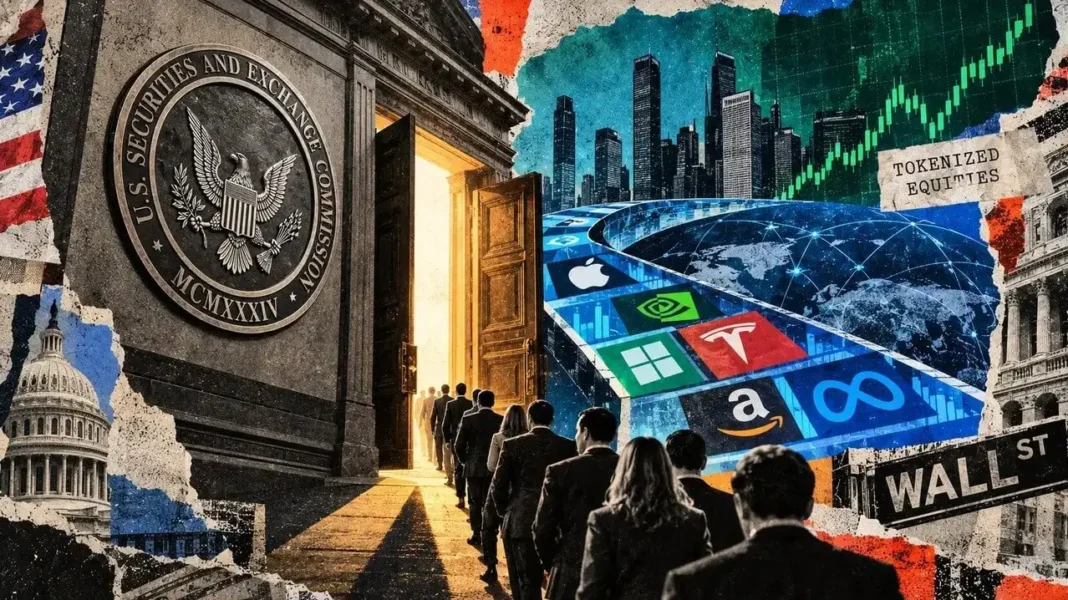

The US Securities and Exchange Commission (SEC) has introduced a five-year pathway enabling regulated US equities to trade on blockchain-native platforms.
The Innovation Exemption was introduced just two days after the Senate failed to advance the CLARITY Act, a sweeping crypto market-structure bill designed to establish statutory rules for digital assets and define regulatory responsibilities. The procedural vote stalled at 49-50, falling short of the 60 votes required to progress.
Consequently, the crypto industry remains without a comprehensive market-structure framework, placing greater emphasis on the actions regulators can take utilizing existing laws.
SEC Chair Paul Atkins explicitly connected the Sept. 17 action to the stalled legislation, stating that the commission was acting “within its statutory authority” to support the on-chain trading of specific tokenized stocks.
This initiative opens the $77 trillion US stock market to crypto-style trading. Nonetheless, the measure addresses the narrower issue of how regulated equities can transact using blockchain infrastructure. It also moves US policy closer to an ecosystem already taking shape overseas, where crypto platforms provide tokenized shares that trade outside standard market hours.
SEC gives on-chain venues a five-year test
The exemption outlines a framework for Tokenized Securities Venues (TSVs), which connect buyers and sellers via permissioned automated market makers and liquidity pools.
Qualifying venues receive temporary relief from classification as traditional exchanges under the Securities Exchange Act, while specific liquidity providers utilizing proprietary capital can obtain corresponding relief from dealer-registration mandates. These exemptions expire after five years, granting the SEC a period to gather trading data before determining the structure of a permanent framework.
Commissioner Mark Uyeda characterized the arrangement as intentionally restricted. The parameters feature symbol and volume limitations, alongside mandates governing transaction transparency, trading halts, recordkeeping, and technical safeguards. Additionally, venues are required to disclose metrics including prices, trade sizes, timestamps, pool addresses, and daily trading volumes.
This development coincided with an SEC roundtable focused on preparations for 24-hour US equity trading, highlighting a broader transition toward markets functioning past standard operating hours.
Atkins remarked that economic and corporate developments no longer transpire strictly within market hours, and investors increasingly demand the capability to adjust positions when news breaks. Furthermore, he highlighted tokenization as a prospective mechanism for real-time inventory management, which could enhance efficiency and minimize settlement failures.
Uyeda similarly noted that tokenization could diminish dependency on intermediaries, streamline transaction lifecycles, and cut operational expenses, provided that traditional securities protections are successfully translated into on-chain environments.
This regulatory opening immediately drew attention from businesses that spent the past year developing tokenized-equity operations overseas.
Robinhood Crypto General Manager Johann Kerbrat stated that the exemption indicates tokenization is prepared for the US market.
He said:
“This is a major step by the agency and will allow liquid tokenized securities markets to develop onshore. Smart regulation accelerates innovation.”
Currently, several US crypto firms, including Robinhood, Kraken, and Coinbase, deliver tokenized US equity products to clientele in international jurisdictions.
Tokenized stocks find trading before financial utility
Those international markets demonstrate that continuous equity access—one of tokenization’s most frequently promoted advantages—is already driving notable activity.
Data from Token Terminal indicates that tokenized stocks achieved a peak market capitalization of $3.2 billion, representing a 1,219.3% increase over the past year. These offerings generated $15.75 billion in decentralized-exchange trading volume over the trailing 30 days, which included $2.95 billion during weekends when traditional US exchanges are closed.
Turnover expanded 4.4-fold over a three-week window, rising from $360 million to $1.6 billion per weekend, which supports the premise that investors utilize tokenized equities partly to execute trades outside standard operating hours.
Token Terminal reported 3.7 million tokenized-stock holders, marking a 4,247.8% surge over the preceding year, though this metric counts on-chain holders rather than necessarily distinct individual investors.
Capital is also migrating from personal wallets and trading venues into decentralized finance. The amount of tokenized-stock value deployed in DeFi has climbed 1,960.8% over the past year to reach $247.8 million.
Even so, trading remains the market’s primary use case.
Grayscale estimated in late August that roughly 5% of the tokenized-equity market was active in on-chain finance, implying that investors have thus far prioritized continuous trading and global accessibility over utilizing equities for lending, collateral, and alternative financial applications.
The SEC’s new exemption could assist in expanding that utility.
Grayscale noted that enhanced regulatory clarity, such as frameworks centered on verified participants and compliance-friendly token standards, could simplify the integration of tokenized securities with lending markets and broader blockchain-based financial architecture.
Such integration would enable tokenized stocks to operate as more than assets available for round-the-clock exchange. They could increasingly function as programmable collateral or be utilized within lending markets, generating additional financial applications for securities already circulating on-chain.
Initial indications of this shift are materializing. Grayscale reported that tokenized equities utilized in lending protocols such as the Solana-based Kamino and Jupiter have grown approximately tenfold over the past year.
The firm indicated that regulatory updates might eventually permit the security and payment components of a transaction to settle concurrently on-chain, mitigating the risk that one counterparty delivers while the other fails.
The exemption establishes a compliant pathway for tokenized securities infrastructure within the US, potentially providing a foundation for platforms to evaluate certain applications under more explicit guidelines.
Issuer vetoes and trading caps limit the experiment
Nevertheless, the SEC has established notable boundaries surrounding this transition.
The exemption is restricted to tokenized National Market System stocks that embody authentic securities. These tokens must grant holders identical rights and privileges as corresponding traditional shares, including dividend and voting rights. Synthetic instruments that merely mirror a stock’s price performance fall outside the framework.
This distinction is significant because several tokenized offerings presently traded internationally feature different structures. For instance, Robinhood characterizes its Classic Stock Tokens in Europe as blockchain-recorded derivatives rather than direct ownership of underlying shares.
Issuers also maintain substantial authority over assets that enter the new platforms. Companies must be given the opportunity to contest efforts by unaffiliated third parties to tokenize their securities, allowing them to block their stock from trading on a TSV.
Venues must be operated by US persons, adhere to Office of Foreign Assets Control sanctions regulations, and restrict participation via permissioned access. Furthermore, trading is subject to limitations on the variety of stocks and the volumes that can change hands.
These restrictions may prove most impactful during overnight and weekend trading periods. Extending market hours can enhance access and enable investors to react more rapidly to breaking news, but limited liquidity can also trigger wider bid-ask spreads and sharper price volatility.
Atkins acknowledged this tension, observing that round-the-clock market infrastructure must uphold the functions and safeguards accessible throughout regular trading hours. He added that market activity may need to mature further before services like securities lending and prime brokerage can function efficiently overnight.
The five-year exemption now offers regulators and market participants a supervised evaluation to determine whether these challenges can be effectively managed.
For crypto enterprises developing tokenized-equity operations, the initiative offers a channel to transition activity that has predominantly grown abroad into the formal US regulatory system.
Frequently Asked Questions
-
What triggered the SEC’s new Innovation Exemption for tokenized stocks?
The SEC’s action followed the Senate’s failure to advance the CLARITY Act, a broad crypto market-structure bill, leaving regulators to act within existing laws to establish a pathway for regulated US stocks on blockchain venues. -
How long does the SEC’s tokenized securities exemption last?
The exemption is structured as a five-year test, giving the SEC a window to gather trading data before deciding on a permanent regulatory framework. -
Can any tokenized stock trade on these new US venues?
No. The exemption applies only to tokenized National Market System stocks that represent genuine securities with the same rights as traditional shares, and issuers have the right to block third parties from tokenizing their stock. Synthetic price-exposure instruments are excluded. -
What are some of the rules imposed on Tokenized Securities Venues (TSVs)?
Venues must be operated by US persons, comply with OFAC sanctions, restrict participation via permissioned access, and adhere to symbol and volume caps, transparent reporting, trading halts, and technology safeguards.