

Intercontinental Exchange and OKX are developing a marketplace that never closes, designed to keep tokenized US equities repricing long after the trading day on Wall Street ends.
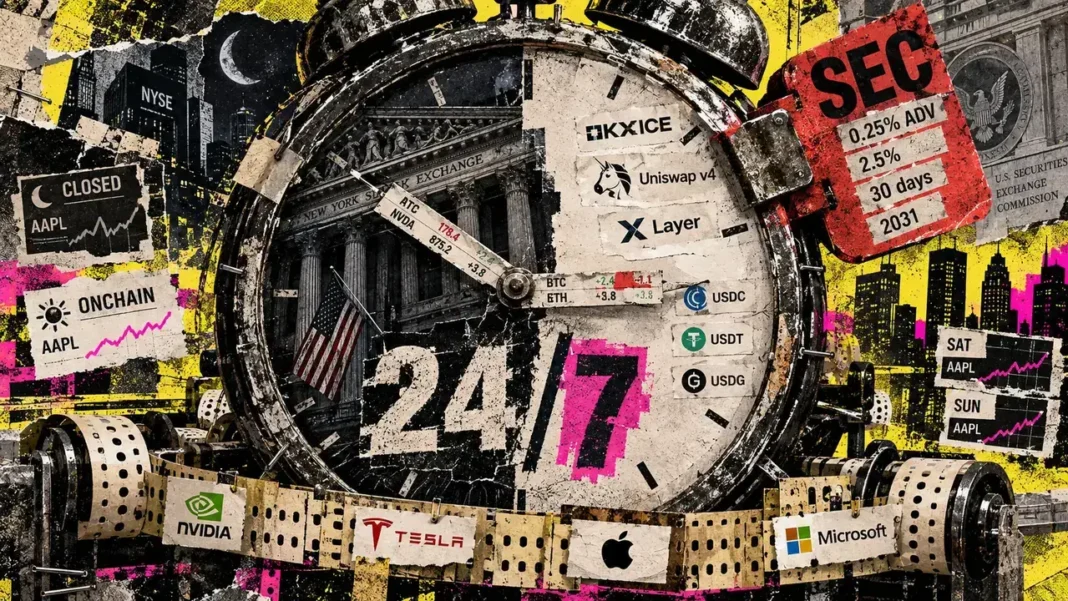
On Oct. 4, OKXICE—the 50-50 joint venture established by the two companies—submitted a notification to the Securities and Exchange Commission (SEC) expressing its plan to launch a Tokenized Securities Venue under the regulator’s Innovation Exemption. The proposed platform aims to feature an initial lineup of 63 securities, which includes names such as Nvidia, Tesla, Apple, Microsoft, JPMorgan, Goldman Sachs, Coinbase, and Circle.
This framework establishes a parallel trading venue for several of the most heavily traded companies in America, operating 24 hours a day, seven days a week. By allowing tokenized shares to process incoming information throughout nights and weekends when conventional cash markets are shut, the system could offer a continuous reference point for where prices might head when standard exchanges open back up.
The participation of ICE brings added weight to the initiative. As the owner of the New York Stock Exchange, ICE is directly involved in building infrastructure that tests whether US equity transactions can move onto blockchain networks beyond traditional business hours.
“This is a landmark step toward a truly global, 24/7 Wall Street,” noted Andrew Cuomo, OKXICE co-chair and former New York Gov. Meanwhile, OKX founder and CEO Star Xu characterized the filing as a market-structure test worth evaluating on a large scale, adding that “Wall Street is moving onchain.”
Onchain prices could fill Wall Street’s dead hours
The market setup grows more significant after traditional exchanges shut down because the smart contracts run by OKXICE will not depend on prevailing prices from the NYSE or Nasdaq to determine how a tokenized stock trades.
Instead, pricing will be driven by asset ratios within automated market maker liquidity pools. While external data from stock markets can be utilized for display purposes and to monitor trading halts, it will not feed directly into the smart contracts that establish executable prices.
Should market-moving developments concerning Nvidia or Tesla surface on a Saturday, investors will have the ability to trade their tokenized shares against stablecoins. Though the resulting value will not dictate the opening price of the underlying stock on Monday, a sufficiently deep liquidity pool could offer market participants an ongoing gauge of investor sentiment before conventional trading restarts.
The usefulness of that indicator relies entirely on liquidity. Thin pools run the risk of generating exaggerated price swings or wide discrepancies from the valuation investors ultimately place on the underlying shares once standard markets open.
The SEC has already pointed out this exact tension. In approving the exemption, the agency invited public feedback regarding how overnight trading of tokenized stocks might influence liquidity, price discovery, and the opening, reopening, and closing phases of traditional exchanges. The regulator also highlighted potential price gaps between tokenized assets and underlying shares as a worry for public companies whose stock might be tokenized by outside parties.
Arbitrage serves as a mechanism to close these gaps once conventional markets reopen. According to the OKXICE filing, third-party tokenizers are required to maintain a one-to-one ratio of underlying shares for every token in circulation, with minting and redemption avenues open to qualified participants. Furthermore, the tokens must provide identical economic and governance benefits, encompassing dividends, voting rights, and claims on residual assets.
This connection could transform discrepancies between onchain and conventional pricing into opportunities for market makers instead of permanent divisions. Even so, unexpected weekend shocks would leave arbitrageurs without an active cash market to instantly hedge or buy the underlying equities.
Uniswap mechanics come to US equities
OKXICE has also outlined plans to substitute traditional exchange order books with decentralized finance architecture.
Its permission-based markets will rely on Uniswap v4 liquidity pools hosted on X Layer, which is the blockchain network created by OKX. Tokenized equities will be paired against USDC, USDT, or USDG, placing stablecoins directly on the cash side of trades involving some of the largest public firms in the United States.
While investors will maintain control of their assets via self-custodial wallets, entry will be tightly controlled. Potential users must successfully clear identity, anti-money-laundering, and sanctions evaluations to obtain a non-transferable credential that permits their wallet to access the venue. The platform will not run an order book, hold customer assets in custody, or provide credit.
This architecture merges regulated securities ownership with crypto-native plumbing. Investors hold fully backed financial instruments that include shareholder rights, while liquidity, settlement, and custody are handled through smart contracts, stablecoins, and self-hosted wallets.
Additionally, authorized participants will be able to mint or redeem tokens using underlying shares during regular market hours, bridging the automated market maker pools with conventional equity markets. Once the cash market closes, however, those pools can keep repricing independently of an active underlying stock market.
SEC limits how far the experiment can run
The SEC has placed strict limits on both the quantity of securities and the trading volume permitted under its temporary exemption.
Under the terms of the SEC exemption, Tier 1 securities are restricted to a maximum of 75 symbols per venue, and trading volume for any single stock cannot pass 0.25% of its average daily volume from the prior month. Tier 2 securities face a limit of 250 symbols alongside a higher volume ceiling of 2.5%. Any venue that breaches these established thresholds for a given security must suspend trading in that token for three months.
These boundaries make it unlikely that OKXICE will quickly build enough volume to challenge the NYSE or Nasdaq. Instead, they provide regulators with a controlled environment to study whether continuous onchain trading can accumulate sufficient liquidity to influence pricing elsewhere.
The exemption is scheduled to run through Sept. 17, 2031, though the SEC retains the authority to modify it sooner as officials evaluate whether a permanent framework is appropriate.
Additionally, OKXICE cannot launch operations immediately. The SEC mandates that prospective trading venues publish notice at least 30 calendar days ahead of opening, setting early November as the earliest feasible launch window following the Oct. 4 notification.
Third-party tokenized stocks encounter another hurdle. Issuing companies must receive a minimum of 30 days’ notice before their shares are listed and possess the right to object during that timeframe, which blocks the venue from offering their tokenized stock under the exemption.
That authority has already been put into practice, as Cerebras Systems objected to having its shares traded through OKXICE, meaning the venue is barred from offering that specific tokenized stock within the current framework.
The coming month will consequently test which planned listings draw objections from issuers and whether liquidity providers are willing to price assets during hours when Wall Street itself is closed.
Frequently Asked Questions
-
What is the OKXICE joint venture proposing?
OKXICE, a 50-50 joint venture between Intercontinental Exchange and OKX, is planning to launch a Tokenized Securities Venue that allows 24/7 trading of tokenized US stocks under an SEC Innovation Exemption.
-
How will tokenized stock prices be determined when Wall Street is closed?
Prices will be determined by asset ratios in automated market maker liquidity pools—specifically using Uniswap v4 infrastructure on OKX’s X Layer—rather than relying on closed traditional exchange order books.
-
Can any company’s stock be tokenized and traded on the platform?
Not necessarily. Issuing companies receive at least 30 days’ notice and can object to having their shares offered, as Cerebras Systems has already done to block its tokenized stock from being listed.
-
What safeguards and limits are placed on the venue?
The SEC has capped trading volumes and the number of securities allowed under Tier 1 and Tier 2 rules. Furthermore, users must pass identity, anti-money-laundering, and sanctions checks to interact with the permissioned platform.