

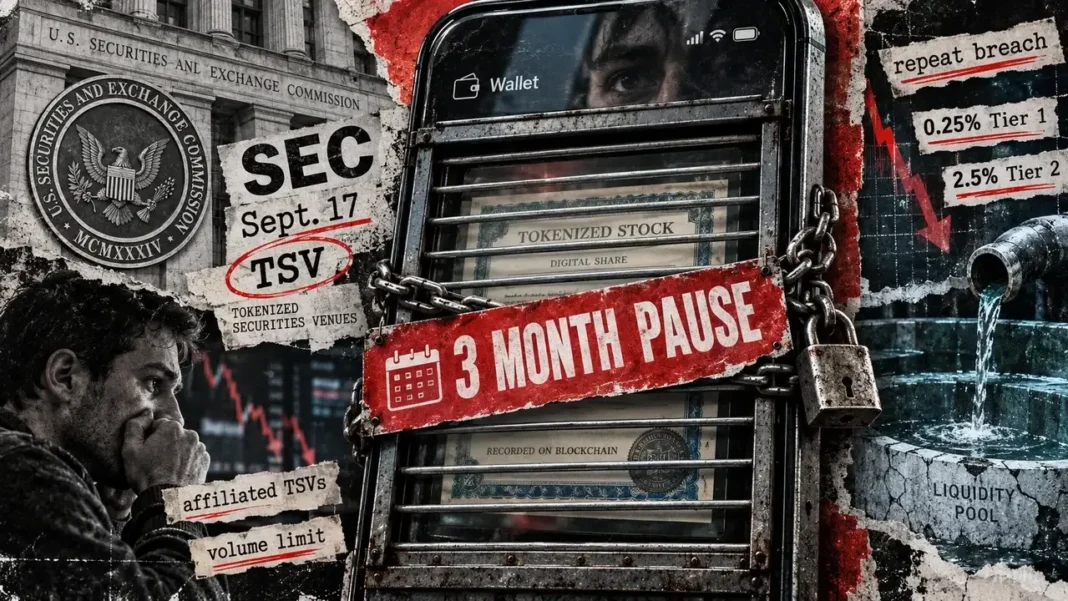

Purchasing a tokenized stock appears straightforward at first glance. You select a familiar business, buy a digital token representing its shares, and store it in a digital wallet. The main attraction is combining traditional stock investing with crypto-like convenience, potentially allowing for trades outside standard exchange hours.
However, discovering a rule that can halt trading for three months reveals that the promise of always-accessible stocks requires a closer look.
This suspension stems from the SEC’s Sept. 17 framework governing experimental Tokenized Securities Venues, or TSVs. It is triggered by repeat violations of a stock’s trading volume limit, applying specifically to that stock on the affected exchange and its affiliates rather than to every version of that tokenized stock across the entire market.
That distinction provides a solid starting point for understanding the product as a whole. Possessing a token, holding the legal rights linked to a share, and having a marketplace to liquidate it are three distinct elements that an application can easily make appear as one.
Same company, different ways to own it
Equities are already predominantly digital. Purchasing shares via a broker typically establishes an electronic ledger of ownership managed through a network of financial institutions. Tokenization integrates blockchain technology into the documentation and transfer of ownership claims.
Because “tokenized” simply denotes the format, investors must investigate what the underlying token actually represents. The SEC’s January guidance on tokenized securities outlines multiple models. Under one structure, an enterprise or its designated agent utilizes blockchain ledgers as a component of its record-keeping system. Under another approach, a third party holds the physical shares and issues tokens reflecting an interest in them.
Additionally, synthetic exposure exists, where a token delivers financial returns correlated with a stock’s performance without granting actual ownership of the underlying company’s shares. Acquiring an instrument that tracks a corporation’s pricing does not inherently confer shareholder privileges.
CryptoSlate has previously examined stock tokens that fail to grant buyer shareholder status. The key takeaway is to look beyond a familiar ticker symbol to determine who holds financial obligations to you. When an independent entity issues the token, its balance sheet and liabilities introduce investment risks alongside the core business whose name initially drew your interest.
The updated SEC initiative pursues a more targeted model. As outlined in CryptoSlate’s review of the framework, eligible tokenized stocks must preserve traditional economic and governance rights, such as voting privileges and dividends; synthetic exposures do not qualify. Furthermore, exchange access is strictly permissioned, requiring participants and their wallets to clear verification protocols.
Within these parameters, regulators are permitting a five-year pilot program for executing trades via automated market makers. Although this sounds technical, the underlying concept is straightforward: rather than pairing your order directly with another user’s order, software enables trades against a shared pool of assets funded by other participants.
In a standard liquidity pool containing stock tokens alongside a payment asset, buying shares removes tokens from the pool and injects payment assets. The pool’s mathematical formula adjusts pricing dynamically as inventory shifts. Uniswap’s documentation on liquidity pools details this foundational architecture, though individual exchanges may deploy alternative formulas and frameworks.
The primary appeal is an automated trading mechanism capable of interfacing with other compatible financial tools. Nevertheless, software still relies on accessible trading inventory, legally enforceable rights backing the tokens, and, most critically, capital providers willing to supply funds.
How the three-month clock starts
The pilot program enforces strict caps regarding the volume of stocks an exchange can list and the trading activity permitted for each. Volume allowances are benchmarked against traditional equity market activity using average daily share volume.
The two regulatory tiers feature distinct thresholds, as outlined in CryptoSlate’s overview of the exemption. Tier 1 encompasses S&P 500, Russell 1000 equities, and select exchange-traded products, while Tier 2 encompasses all other qualifying securities.
| Stock category | Maximum symbols across affiliated exchanges | Per-stock volume threshold |
|---|---|---|
| Tier 1 | 75 | 0.25% of the traditional stock’s prior-month average daily share volume |
| Tier 2 | 250 | 2.5% of the traditional stock’s prior-month average daily share volume |
The SEC order’s volume-limit provisions compare average daily tokenized volume against average daily traditional volume while combining activity across affiliated exchanges. Because this evaluates average volume, a single day of heavy trading does not automatically constitute a violation.
For instance, if a traditional equity averaged 10 million shares daily over the prior month, the Tier 1 allowance would equate to 25,000 shares in average daily tokenized volume. This relative comparison is the critical metric to monitor, rather than a rigid monetary sum or a personal holding cap for individual investors.
The consequences for exceeding limits escalate progressively:
- The initial volume violation for a specific stock receives a grace period, during which the exchange must implement corrective measures to guarantee future compliance.
- Subsequent violations for that same stock mandate an immediate three-month trading halt, which extends to all affiliated TSVs. The suspension period commences on the exact date of the breach, though trading for other unrelated stocks may continue normally.
- Exchanges retain the option to proactively halt trading ahead of time to prevent threshold breaches. They are required to issue immediate notifications to participants regarding either scenario and update their public disclosures within five business days.
The SEC’s rationale for maintaining low activity limits is to mitigate systemic risks to the broader equity market while monitoring the pilot, including potential divergences between pool pricing and traditional market valuations.
A simplified scenario illustrates how price divergence can occur: if a liquidity pool maintains restricted inventory while multiple buyers attempt simultaneous purchases, the internal pricing formula can drive the token’s value higher, even when broader market sentiment for the enterprise remains unchanged. Traders may spot arbitrage opportunities to realign pricing, yet execution relies entirely on accessible capital and operational pathways between separate markets.
By establishing boundaries around the scale of the pilot, the regulator ensures that repeated threshold crossings carry heavy operational penalties, incentivizing exchanges to actively manage market activity before limits are reached.
Owning tokenized stocks and selling them are different jobs
The most pressing practical challenge for buyers is securing an exit strategy. Consider an investor who purchases a tokenized share with the expectation of liquidating it to cover an urgent expense: a sudden trading freeze could derail that plan, leaving them holding an illiquid asset.
Transferring the token to an alternative wallet does not inherently resolve the issue. Investors require a compliant marketplace capable of supporting that exact instrument or a functional redemption mechanism outlined in its terms. Whether such avenues exist depends entirely on the specific product, supporting financial institutions, and applicable regulatory permissions.
The three-month restriction should not be interpreted as a guarantee that alternative brokers will accept the token, nor as a universal ban on all potential transfers. These remain distinct, product-level considerations, and purchasers require concrete answers rather than assumptions drawn from how fluidly standard tokenized assets sometimes move between applications.
This reality also warrants a second look at the marketing pitch of extended trading hours. Accessing a trading application at midnight provides zero assurance regarding the price execution available for liquidating a substantial position. SEC Commissioner Mark Uyeda highlighted this exact trade-off during the agency’s 24-hour trading roundtable, noting that expanded hours carry an equal likelihood of spreading market liquidity too thin rather than distributing it smoothly.
Before executing a purchase, the most revealing document a provider can supply is a concrete, worked example illustrating what happens to the token if the host exchange suspends trading. That explanation should detail asset custody, ongoing shareholder privileges, permitted transfer protocols, available redemption pathways, and associated costs. Furthermore, it must clearly separate current service capabilities from features the provider merely hopes to roll out eventually.
Tokenizing assets to streamline share transfers and link ownership ledgers directly with trading software offers clear benefits. These technological upgrades have the potential to eliminate friction and enhance convenience across financial services, with the SEC’s five-year pilot granting firms ample space to test the model.
Ultimately, the prospect of a three-month trading freeze brings investors back to a fundamental financial principle: any asset requires a reliable route to liquidation. Until you fully understand that exit path, simply seeing a stock balance in your digital wallet reveals only part of the complete picture.
FAQs
-
What triggers a three-month trading pause for a tokenized stock?
A three-month suspension is triggered by repeat violations of a stock’s specific trading volume limits on a Tokenized Securities Venue and its affiliates, as outlined in the SEC’s framework.
-
Do tokenized stocks grant traditional shareholder rights?
Only qualifying tokenized stocks under the SEC’s specific framework preserve economic and governance rights like dividends and voting. Synthetic exposure models provide price tracking but do not confer actual shareholder status.
-
How are volume limits calculated for tokenized stocks?
Volume limits are measured as a percentage of the traditional stock’s prior-month average daily share volume. Tier 1 stocks are capped at 0.25%, while Tier 2 stocks are capped at 2.5%.
-
What happens if a trading pause goes into effect?
Trading for that specific stock is frozen for three months on the exchange and its affiliates, though other stocks on the platform can continue trading normally.