

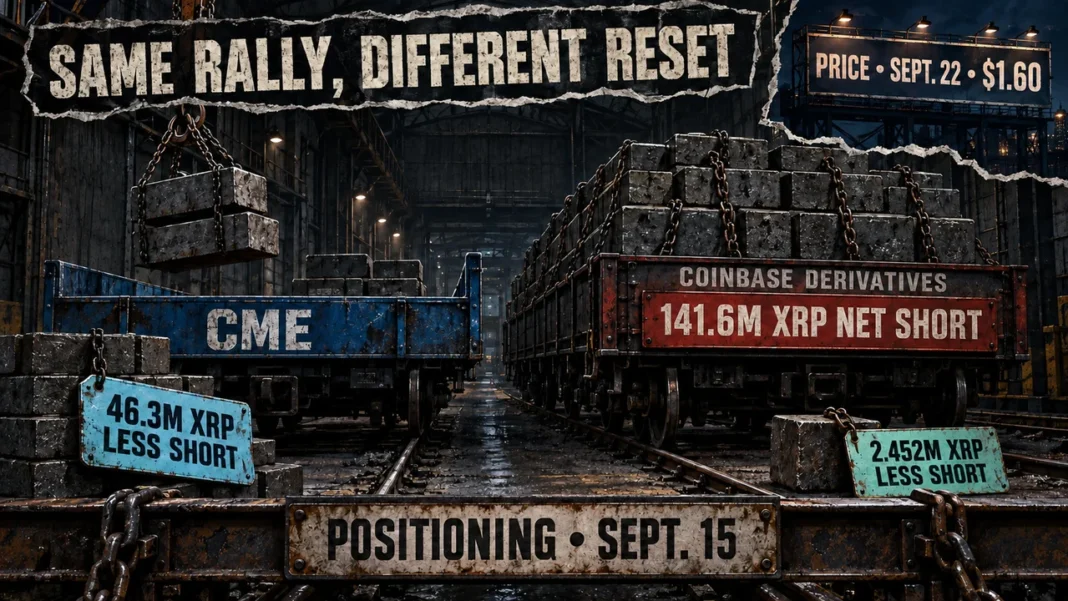

On September 22, XRP hit an intraday peak of $1.60 accompanied by approximately $7.4 billion in reported volume. Although the price movement was significant, the latest public figures from regulated futures venues reveal varying shifts in market positioning across different platforms.
Data from the Commodity Futures Trading Commission for September 15 showed that leveraged funds slashed their net short positions in CME futures by an amount equivalent to 46.3 million XRP over the span of a week. The term net short indicates that reported short contracts outnumbered reported long contracts.
Meanwhile, across three distinctly reported Coinbase Derivatives products—normalized for each contract’s specific unit size—the same group of traders lowered their combined net short by just 2.452 million XRP, leaving them short by roughly 141.6 million XRP.
This discrepancy points to a targeted positioning reset. Furthermore, the timeline prevents a direct causal connection: the positions were recorded on September 15 and published on September 18, which preceded the September 22 price peak.
CME’s reset dwarfed the Coinbase shift
A standard CME future accounts for 50,000 XRP per contract. As of September 15, leveraged funds held 1,585 long contracts and 2,304 short contracts, resulting in a net short of 719 contracts, which translates to 35.95 million XRP.
In the preceding week, their reported holdings stood at 1,280 longs versus 2,925 shorts, representing 1,645 net short contracts or 82.25 million XRP. Consequently, the weekly comparison shrank the net short by 926 contracts, or 46.3 million XRP.
This adjustment stemmed from a combination of increased long positions and decreased short positions. Long holdings among leveraged funds grew by 305 contracts, while short positions dropped by 621. While shrinking short exposure accounted for the bulk of the shift, some fresh long exposure was also introduced.
During that same weekly window, open interest dropped by 509 contracts, equivalent to 25.45 million XRP. This drop aligns with traders liquidating positions even as the category added new long exposure.
Coinbase displayed a more modest alteration after its three reported product offerings were converted into XRP-equivalent totals. A standard Coinbase future equates to 10,000 XRP per contract, whereas the NANO XRP and NANO XRP PERP STYLE products listed in the CFTC data each represent 500 XRP per contract.
| Reported market | Sept. 8 leveraged-fund net short XRP | Sept. 15 leveraged-fund net short XRP | Weekly change |
|---|---|---|---|
| CME, 50,000 XRP per contract | 82.25 million | 35.95 million | 46.30 million XRP less short |
The standard contract drove most of Coinbase’s minor adjustment, with the nano contract adding another 92,000 XRP to the change. Conversely, the perpetual-style contract moved in the opposite direction, as leveraged funds grew 1.29 million XRP more net short.
This expansion counteracted part of the contraction seen in the other two offerings. As a result, the aggregate Coinbase total remained nearly four times higher than the CME net short on September 15, having shifted by only a fraction of the amount over the week.
Unlike the unexpiring swaps frequently found on offshore platforms, the Coinbase perpetual-style product is a regulated, five-year cash-settled future that implements funding adjustments. Its positioning can capture a distinct blend of participants and trading strategies, which highlights the importance of individual product rows.
Overall, CME experienced much greater movement than Coinbase, and Coinbase’s various products shifted in opposing directions. Taken together, the evidence provides weak backing for a broad, market-wide directional pivot.
What the XRP positioning can and cannot show
The CFTC’s leveraged-funds grouping encompasses market participants whose primary self-reported business activities match that definition. While the report contains a separate category for mechanical spreading positions, neither metric clarifies the underlying motive behind any specific long or short contract.
A short position might signal a bearish outlook, serve as a spot hedge, offset a separate derivative, or act as one leg of a basis trade. Unwinding that position can indicate growing bullish sentiment, an adjustment to a hedge, the closing of a relative-value trade, or a broader reduction in overall risk exposure. Public aggregates do not reveal the identities of individual firms or the exact economic purpose of each contract.
These limitations matter because the headline CME adjustment combines a rise in longs, a drop in shorts, and a decrease in overall open interest. The data reliably supports the conclusion that leveraged-fund exposure on the CME became substantially less short, but labeling this entire shift as fresh directional buying—or attributing XRP’s subsequent price gains directly to it—goes beyond what the evidence proves.
Furthermore, the comparison is restricted to the four contract families included in the dated CFTC query, as CME lists Micro XRP as an independent product. Per CFTC guidelines, a market is only featured in Commitments of Traders reports when a minimum of 20 traders maintain positions meeting or exceeding reporting thresholds.
A missing table row means activity in another product remains undisclosed, and the reporting threshold is merely one possible explanation for a specific absence.
The reporting lag now serves as the upcoming test. CFTC reports typically capture Tuesday positions and are generally published on Fridays at 3:30 p.m. Eastern time. The agency’s tentative 2026 calendar lists September 25 for the report that normally covers September 22.
That upcoming snapshot will reveal whether the cross-venue divergence continued throughout the rally, while direct price causation remains outside the scope of weekly positioning data.
Evidence for a broader directional shift would strengthen if Coinbase’s combined net short also declined significantly, particularly alongside growing open interest. If Coinbase maintains a heavy short posture while CME stays significantly less short, the data will continue to point toward a venue-specific reset.
At present, three facts can coexist without forcing a single causal narrative: XRP experienced a rally, CME leveraged funds had previously wound down a substantial net short, and comparable Coinbase positioning had barely shifted on an aggregate basis.
This divergence serves as the primary signal, while the underlying motivations remain outside what weekly category metrics can verify.
FAQ
What caused XRP’s volume to surge to $7.4 billion?
XRP registered an intraday high of $1.60 on Sept. 22 with about $7.4 billion in reported volume, alongside public data showing varying shifts in regulated futures positioning across different venues.
How much did leveraged funds reduce their net short on CME?
The CFTC’s Sept. 15 snapshot showed leveraged funds cutting their net short in CME futures by the equivalent of 46.3 million XRP in a single week.
Did Coinbase experience a similar positioning shift?
Across three separately reported Coinbase Derivatives products, leveraged funds reduced their combined net short by only 2.452 million XRP and remained short by approximately 141.6 million XRP.
What are the limitations of CFTC weekly positioning data?
Public aggregates do not identify individual firms or the economic purpose behind each contract, meaning a short reduction could reflect bullish sentiment, a hedge adjustment, a relative-value unwind, or a risk reduction rather than definitive directional buying.