

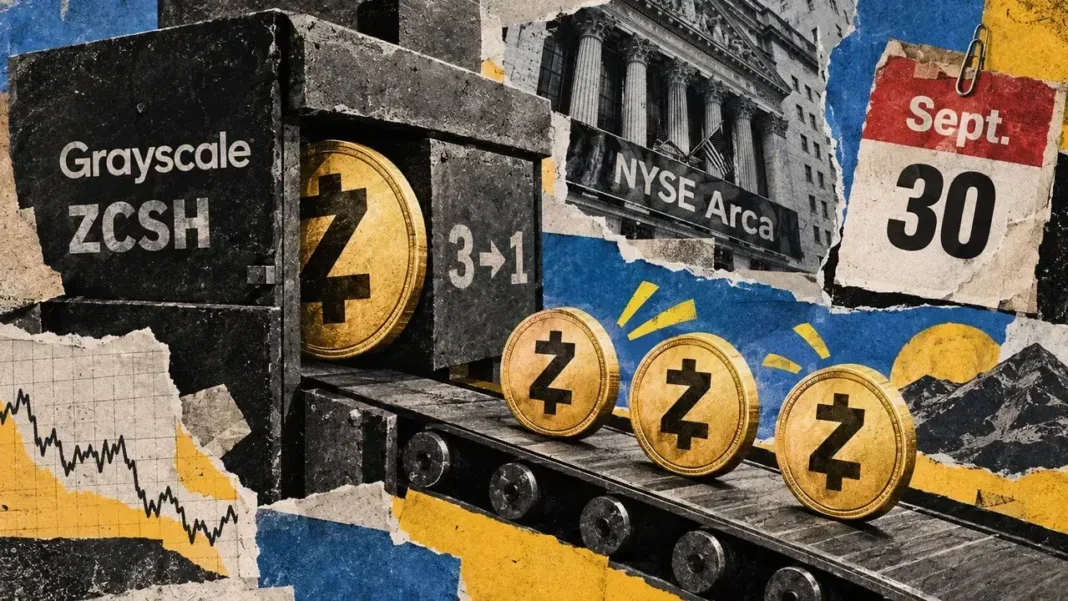

Grayscale’s Zcash ETF is fast approaching the $1 billion milestone in assets, sitting just under a month after its introduction on Wall Street.
Data from SoSoValue indicates that the fund, which lists as ZCSH on NYSE Arca, has gathered $914.53 million in net assets alongside $270.95 million in cumulative net inflows. This swift growth mirrors Zcash’s value roughly doubling since the product launched its trading activity on Aug. 25.
Since Sept. 8—when Grayscale reported that the fund had surpassed $500 million a mere two weeks following its listing—ZCSH has taken in an additional $400 million in assets. This rapid acceleration leaves the vehicle about $85 million away from the $1 billion threshold as sustained investor demand meets one of ZEC’s most robust multi-year rallies.
ZEC rally pushes derivatives activity to records
According to data from CryptoSlate, ZEC changed hands at around $1,540 on Sept. 19, which is approximately twice the price level recorded when ZCSH first began trading on NYSE Arca.
This upward price movement has spilled over heavily into derivatives markets.
CoinGlass figures highlight that ZEC futures open interest surged to an all-time peak of roughly $3.5 billion during the week, while futures trading volume surpassed $10 billion for the initial time since early June.
This accumulation signals that market participants are dedicating significantly more leveraged capital to ZEC alongside its rising spot price. Although high open interest does not guarantee a uniformly bullish market posture, the combination of record exposure and elevated turnover leaves the market more vulnerable to sudden reversals and liquidation cascades.
The price appreciation has also occurred alongside several pivotal decisions concerning Zcash’s monetary policy and upcoming network upgrade.
Earlier this month, Zcash holders voted in favor of preserving the network’s Bitcoin-inspired halving schedule instead of transitioning to a smoother issuance model. Roughly 2.4 million ZEC participated in this advisory vote, accounting for about two-thirds of the eligible supply.
Voters also supported postponing the reissuance of tokens collected via the Network Sustainability Mechanism until 2031. This mechanism temporarily withdraws a share of transaction fees from active circulation before those tokens can eventually re-enter the supply through future block rewards, all while safeguarding Zcash’s fixed maximum supply of 21 million.
These outcomes maintain core scarcity traits just as regulated exposure to ZEC broadens through the ZCSH vehicle.
In a separate vote, holders endorsed shortening block times from 75 seconds down to 25 seconds under the framework of the upcoming NU7 upgrade. They additionally backed pushing forward with NU7 as expeditiously as possible, while leaving out any features that fail to meet an implementation-readiness deadline of Sept. 30.
Because these determinations remain advisory, they require full technical implementation, leaving developers to decide which specific components will ultimately be integrated into the upgrade.
For ZCSH, the underlying cryptocurrency’s surge has delivered an immediate impact on the fund’s asset valuation.
Because the investment product holds ZEC directly, upward moves in the digital asset elevate the value of holdings already inside the fund alongside incoming investor creations. This dynamic helps account for why ZCSH’s asset base of $914.53 million is over three times larger than its cumulative net inflows of $270.95 million.
Grayscale moves to lower ZCSH’s per-share price
The rapid climb in the per-share value of ZCSH is now prompting a structural adjustment to the fund’s shares.
On Sept. 18, Grayscale announced a 3-for-1 forward split designed to triple the total number of outstanding ZCSH shares while adjusting the net asset value per share down to roughly one-third of its pre-split valuation.
Shareholders who own the stock at the close of trading on Sept. 28 will be granted two extra shares for every individual share currently owned. The distribution is slated to take place after markets close on Sept. 29, with split-adjusted trading anticipated to launch prior to the opening bell on Sept. 30.
The corporate action will not alter the total aggregate value of any investor’s holding on its own. While holders will possess three times the quantity of shares, each share will represent a proportionately smaller slice of the fund.
Reducing the nominal share price can simplify whole-share purchases, particularly following a dramatic increase in the underlying asset’s market value. Grayscale has not stated that the adjustment is intended to drive up demand or liquidity, and the fund will continue using its current CUSIP and ZCSH ticker.
This timeline places the fund’s primary share modification right alongside another critical date for the network itself, as Sept. 30 marks the implementation-readiness deadline for proposed NU7 features.
Should inflows persist and ZEC maintain its recent gains, ZCSH could breach the $1 billion milestone ahead of that date. At the same time, record derivatives exposure indicates that any steep token drawdown would rapidly impact the value of the underlying ZEC supporting the fund, leaving the next phase of asset growth tied tightly to both ongoing investor demand and the resilience of the rally.
Frequently Asked Questions
What is the current asset value of Grayscale’s Zcash ETF?
The fund has accumulated $914.53 million in net assets and $270.95 million in cumulative net inflows.
Why is Grayscale splitting the ZCSH shares?
Grayscale announced a 3-for-1 forward split to triple the number of outstanding shares and lower the net asset value of each share to roughly one-third of its pre-split level, making whole-share purchases more accessible.
What prompted the recent spike in ZCSH assets?
The asset growth is driven by a combination of new investor creations and a roughly 100% rally in Zcash’s spot price since the fund began trading on Aug. 25.
What changes were recently voted on by Zcash holders?
Holders voted to keep the Bitcoin-style halving schedule, delay token reissuance from the Network Sustainability Mechanism to 2031, shorten block times to 25 seconds under the NU7 upgrade, and advance NU7 quickly while dropping features that miss the Sept. 30 readiness deadline.
When will the ZCSH stock split take effect?
Shareholders of record at the close on Sept. 28 will receive their distribution after the market closes on Sept. 29, with split-adjusted trading beginning before the opening bell on Sept. 30.