

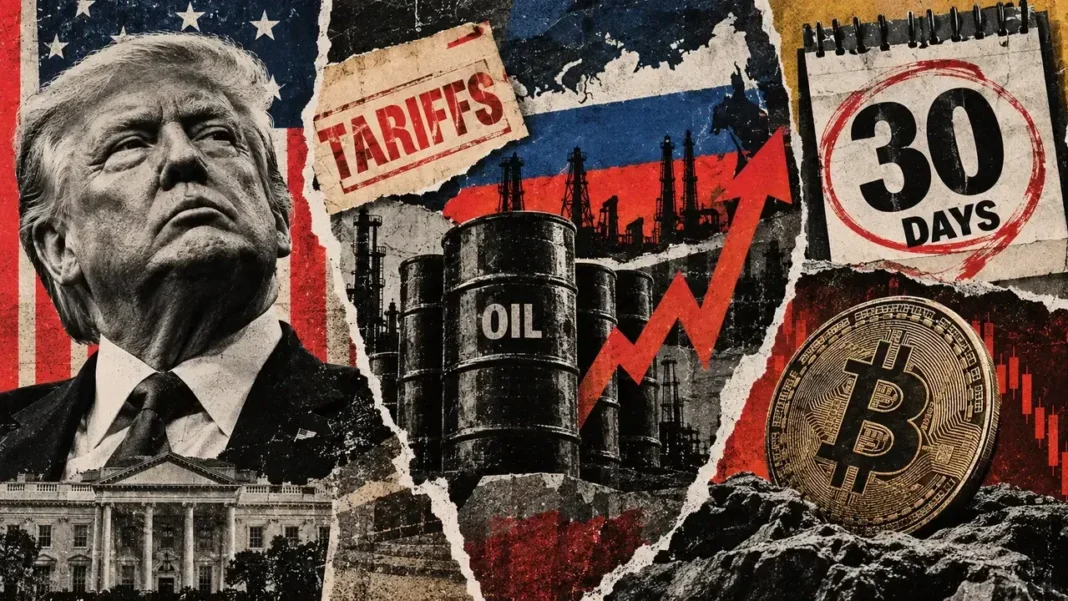

President Donald Trump’s enactment of a new Russia sanctions law has established Oct. 18 as an important macro deadline for Bitcoin traders to monitor.
Following Trump’s Sept. 18 signature on H.R. 5334, a 30-day window began for the administration to establish tariffs capable of disrupting Russian energy trade. This disruption could potentially influence inflation, Treasury yields, and the dollar. These economic channels are critical for Bitcoin because tighter financial conditions have historically exerted downward pressure on crypto markets.
Under the legislation, the president is required to increase duties on all US imports of Russian goods—including petroleum products, natural gas, and oil—by as much as 500%. Because this figure serves as a ceiling instead of a mandatory rate, the administration retains substantial discretion regarding the aggressiveness of the rollout.
A separate provision introduces the potential for a broader trade shock. Nations that continue purchasing Russian natural gas or crude following the 30-day period may face tariffs of up to 100% on all goods they export to the US, provided they rank among the five largest buyers. This identical ceiling is applicable to the five nations considered to be facilitating the evasion of Russian oil sanctions.
Because the legislation leaves these countries unnamed and does not mandate an initial minimum tariff, the actual implementation carries more significance for markets than the headline ceilings.
Consequently, Oct. 18 serves as an early barometer to determine whether the legislation will transform into a major macro shock or remain a restricted sanctions policy.
Before imposing or adjusting duties via the third-country provision, the US Trade Representative or the president must supply six congressional committees with a written justification at least 10 days in advance, detailing both the methodology used to select the targeted country and the chosen tariff rate.
The administration also maintains avenues to mitigate the impact. The law features an exemption for select natural-gas purchases and grants Trump the authority to waive duties upon certifying to Congress that the action aligns with US national interests.
Energy prices become the key transmission channel for Bitcoin
For Bitcoin, energy markets represent the primary area to watch.
Substantial tariffs levied against nations that remain primary buyers of Russian gas or crude could shift trade patterns if ongoing purchases become politically or economically prohibitive.
The resulting impact on global gas and oil prices will rely on the specific countries targeted, the chosen tariff rates, and whether Russian supplies manage to find alternative routes rather than being entirely removed from the market.
Should energy prices stay elevated, the implications for inflation grow more severe.
Federal Reserve Governor Christopher Waller noted earlier this year that persistent rises in energy expenses can bleed into the pricing of other services and goods as companies absorb higher input costs. He additionally cautioned that continuous tariff and energy shocks might drive up inflation expectations and complicate monetary policy.
This risk materializes while the Fed is already maintaining restrictive policies.
On Sept. 16, the central bank lifted its benchmark interest rate by a quarter of a percentage point to a bracket of 3.75% to 4%. Officials stated that inflation stayed elevated and that policy would continue working to bring it back down to the 2% target.
Consequently, a renewed inflation surge driven by energy could constrain the Fed’s ability to ease financial conditions. Elevated inflation expectations can drive the dollar and Treasury yields higher, which raises capital costs and diminishes the liquidity accessible for risk assets.
Crypto markets have historically proven vulnerable to this environment. Research published by the Bank for International Settlements demonstrated a correlation between tighter US monetary policy, declining crypto valuations, and decreased stablecoin demand, thereby tying digital-asset liquidity closer to traditional financial conditions.
This dynamic leaves traders with a specific sequence of signals to evaluate before determining the true impact of the sanctions law on Bitcoin.
The initial signal will come from the administration’s notices to Congress, which should clarify which nations are targeted and how closely tariff rates approach the statutory ceilings. Following that, gas and oil prices will offer the clearest indication of whether the policy is significantly disrupting energy flows.
Additionally, inflation expectations, bond yields, and the dollar will reveal if any energy-related shock is starting to influence monetary conditions.
If implementation is mild, waivers are widely utilized, or energy markets remain stable, the transmission effect will be minimized. Conversely, aggressive tariffs directed at major buyers of Russian energy, paired with sustained pressure on gas or oil, would heighten the chances of the sanctions regime becoming another limitation on financial conditions.
This distinction will become clearer ahead of Oct. 18, when the administration must transition from the broad tariff powers granted by the law to identifying the specific countries and rates that will define its economic impact.
Frequently Asked Questions
What is the significance of October 18 for Bitcoin traders?
October 18 marks the end of the 30-day window established by President Trump’s signing of H.R. 5334, by which his administration must determine tariffs on Russian energy trade that could influence inflation, the dollar, and Treasury yields—factors that historically impact crypto markets.
How high can the tariffs go under the new Russia sanctions law?
The law allows the president to raise duties on all imported Russian goods—including oil and natural gas—by up to 500%. Additionally, countries that continue purchasing Russian crude or natural gas can face tariffs of up to 100% on all goods they export to the US if they rank among the five largest buyers or facilitators of sanctions evasion.
Can the administration waive or soften these tariffs?
Yes. The legislation contains an exception for certain natural-gas purchases and gives President Trump the authority to waive duties if he certifies to Congress that doing so serves US national interests.
How does the Federal Reserve’s policy tie into this?
The Fed recently raised its benchmark interest rate to a range of 3.75% to 4% to combat elevated inflation. Energy-driven inflation shocks could further restrict the Fed’s ability to ease monetary conditions, driving up Treasury yields and the dollar while reducing liquidity for risk assets like Bitcoin.