

Crypto Twitter, now known as X, has long been a venue where commentators with illustrated animal profile pictures argue that your financial future hinges on a newly discovered token. Now, X’s Cashtag links are reducing the distance between that conversation and a crypto exchange.
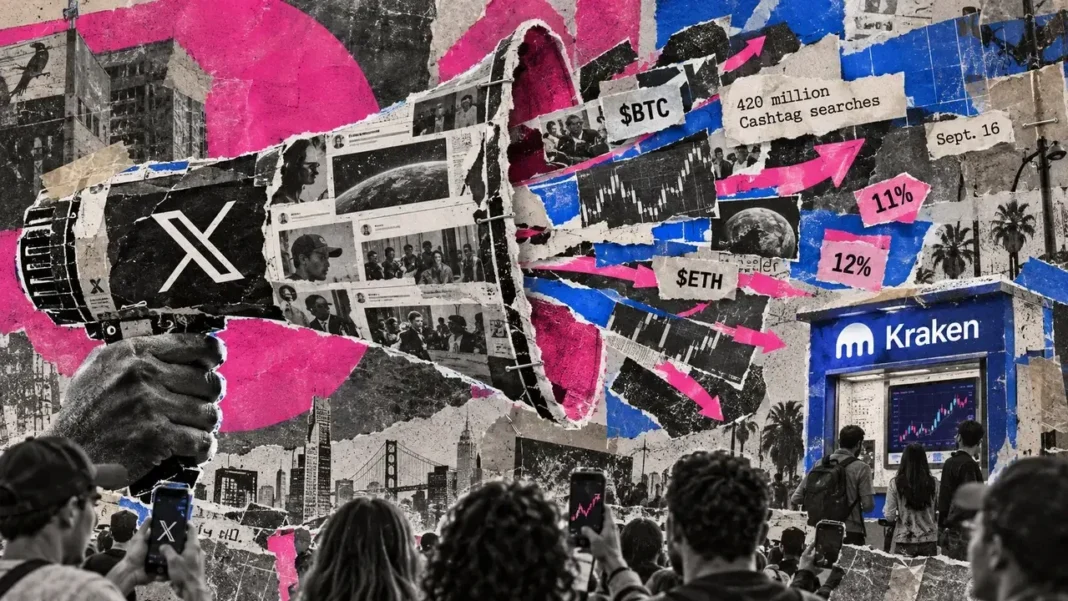
On September 16, Kraken joined the US Cashtag partner program on X, providing users with another pathway from tickers like $BTC directly to its platform. Tapping a Cashtag can pull up related posts and a price chart on X, while the trading link redirects users to Kraken’s website or app, where they can sign in or register to complete a purchase.
Kraken’s announcement frames this integration as a way to increase visibility within applications people already use. This marks the core significance of the agreement. X is not operating as an exchange, and trades continue to be executed on Kraken. The primary change lies in the shortened gap between discovering an asset and reaching a platform where it is sold.
Historically, that gap has been surprisingly wide within the crypto space. An individual might first learn about Bitcoin on X, read an explanatory thread, search for prices elsewhere, compare multiple exchanges, create an account, deposit funds, and finally return to the asset encountered several steps earlier. Cashtag links condense a portion of that journey directly into the environment where the initial interest arose.
Exchanges want to own the next Cashtag click
Twitter experimented with this exact concept prior to its rebrand as X. In 2023, eToro integrated Twitter Cashtags with its platform, highlighting 420 million Cashtag searches during the first three months of that year. While those searches did not equate to 420 million investors or trades, they demonstrated why exchanges value this corner of the internet.
Users searching for terms like $BTC or $ETH have already completed a valuable step from a financial firm’s perspective: they have identified the specific asset that has caught their attention.
Conventional advertising must first locate individuals who might want to invest and then persuade them to care about a specific product. Cashtag traffic begins much further along that path. Users are already viewing the asset, reading debates, checking pricing, or observing others trade it.
Consequently, the subsequent click holds significant value. Kraken does not need every user who opens a Cashtag to execute a purchase; it needs to remain a top-of-mind option when reading about an asset transitions into a desire for exposure.
This subtly alters competition among exchanges. While fees, liquidity, and execution remain critical once investors begin comparing trading platforms, distribution dictates which platforms make the initial cut for comparison.
Crypto companies have spent years competing for the physical locations where people trade. Increasingly, they are also vying for the places where people decide they want to trade.
The X feed is becoming part of the financial interface
This is what makes the X integration more compelling than a standard referral link.
The social and financial dimensions of crypto have always been unusually intertwined. Asset prices fluctuate around online posts, memes serve as investment theses, founders announce products directly to token holders, and traders narrate their positions publicly while others decide whether to copy them.
The industry did not require X to invent social investing, as much of crypto already operated in that manner. Cashtag integrations simply formalize the subsequent step.
The same feed can now help generate interest, reinforce it through repeated exposure, display pricing, and direct users to a place where they can take action. The exchange still handles the transaction, but the social network becomes part of the funnel that produced it.
This could prove crucial for adoption because people rarely wake up wanting an abstract financial product. They encounter it through peers, online communities, creators, news, humor, arguments, and prevailing public discussions.
X already concentrates much of this process for the crypto sector. Its recommendation algorithms use signals like likes, reposts, replies, and network connections to determine what users might want to see, while the For You feed distributes content beyond the accounts users intentionally follow.
These systems are engineered to capture attention rather than evaluate whether an investment is prudent. However, when trading access appears right alongside the conversation, attention translates into financial action much more quickly.
This does not automatically render the resulting decisions inferior. Crypto users who already know their intentions may prefer reaching a familiar exchange without breaking the flow of their reading. Simultaneously, fewer steps can lower barriers for newcomers who previously found cryptocurrency overly complex to navigate.
The broader implication is that mainstream adoption relies less on convincing people to enter a separate, dedicated crypto ecosystem. Instead, financial products are integrated directly into the spaces where people already spend their time.
This represents a different model of mainstreaming. Individuals do not necessarily adopt crypto by transforming into “crypto people” and restructuring their online routines around exchanges, wallets, and specialized websites. Rather, they encounter an asset in a standard feed, tap the ticker, and transition into a financial service from there.
Through this process, the dividing line between media and financial distribution grows thinner. Minimizing friction carries clear commercial utility, as every extra step gives consumers another chance to abandon a transaction.
Nevertheless, removing those steps also amplifies the influence of whatever sparked the initial impulse.
Research indicates that financial interfaces can alter behavior. In a 2024 experiment involving more than 9,000 consumers, the UK’s Financial Conduct Authority discovered that certain app design features heightened trading and risk-taking. Push notifications boosted trading volume by 11%, while points and prize draws increased it by 12%.
While that experiment did not focus on X and cannot predict Cashtag user behavior, its underlying lesson is straightforward: how a financial decision is presented influences how people act. On X, that presentation begins long before a user ever reaches an exchange.
Investors may have already reviewed a bullish thread, watched a token trend, read dozens of replies, or encountered the same ticker repeatedly before clicking through to trade. By that point, the exchange is not generating the idea; it is receiving a user whose conviction was built elsewhere.
This makes social distribution exceptionally powerful for crypto, as the feed does not need to sell the financial service directly. It only needs to make the asset feel significant enough to investigate further. The trading platform manages the rest.
Traditional financial questions remain at the end of that journey. Kraken’s fees depend on the product and execution method, and users must still evaluate the quoted price, spread, account eligibility, and whether they truly want the asset they are about to purchase.
Yet those details are no longer the most noteworthy aspect of the integration. The larger transformation concerns where the investment decision originates.
Crypto exchanges used to function as destinations visited only after a decision to buy had already been made. Increasingly, social platforms have the opportunity to become the environment where discovery, conviction, and the first step toward execution occur simultaneously.
For an industry that has historically expanded through online communities, this could serve as a far more powerful adoption channel than any standalone trading feature.
Crypto Twitter spent years telling people what to buy. Now, it can also point them directly to the checkout.
Frequently Asked Questions
What are X Cashtag links in the context of crypto?
X Cashtag links allow users to tap tickers like $BTC to view related posts and price charts directly on the platform. Through new partnerships, these links can also send users directly to crypto exchanges like Kraken to complete a purchase.
Is X becoming a cryptocurrency exchange?
No. X is not operating as an exchange. The actual trade still takes place on external platforms like Kraken, while X simply shortens the distance between discovering an asset and reaching a place that sells it.
Which cryptocurrency exchange recently partnered with X’s US Cashtag program?
Kraken joined X’s US Cashtag partner program on September 16, giving users a direct route from Cashtags to its exchange application and website.
Why are social platforms valuable for crypto distribution?
Crypto discovery, community discussion, and conviction-building naturally happen on social feeds like X. Integrating trading links directly into these conversations removes friction, allowing users to transition from social interest to financial action without leaving their reading flow.