
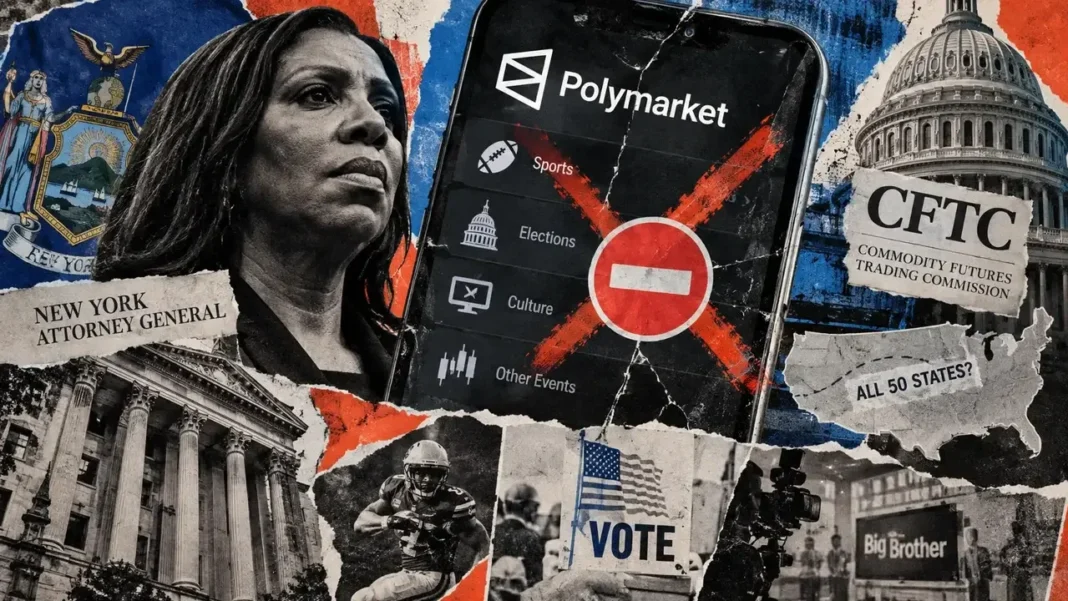

New York has initiated legal action against Polymarket, contending that its United States prediction platform functions as an unauthorized gambling enterprise across the territory.
Attorney General Letitia James petitioned a New York state court on Sept. 24 to bar QCX LLC—doing business as Polymarket US—from providing event contracts lacking a state gaming permit. The filing also requests restitution, disgorgement, and potentially heavy financial penalties. The lawsuit encompasses contracts associated with culture, elections, sports, and alternative events.
This enforcement action is directed at an entity that simultaneously holds federal-level oversight. Since July 2025, QCX has maintained status as a Commodity Futures Trading Commission (CFTC)-designated contract market, which embeds this lawsuit within an ongoing conflict regarding how state gambling regulations intersect with federal derivatives supervision.
New York says Polymarket contracts amount to gambling
The state’s legal argument builds directly upon the architecture of Polymarket’s contracts.
Participants purchase contracts centered on future event outcomes, where successful positions payout based on whether the targeted event materializes. The state maintains that because users wager funds on results outside their command, these exchanges fulfill New York criteria for gambling.
The court filing characterizes Polymarket as presenting activities that are “quintessentially wagering” disguised as event contracts, asserting the firm accepts public bets absent any authorization from the New York State Gaming Commission.
Kathy Hochul, New York’s Governor, stated:
“Calling it a ‘prediction market’ doesn’t change the facts. If you’re taking bets in New York, our gambling laws apply.”
The state highlighted Polymarket’s promotional strategies within its complaint. The enterprise rolled out its US application in December 2025 featuring “sports—followed by markets on everything” while promoting itself as “legal in all 50 states.” An antecedent campaign promised users the ability to “TRADE EVERY FOOTBALL GAME IN ALL 50 STATES.”
Investigators noted that the platform featured markets touching upon college football contests, the New York Mets, reality television program “Big Brother,” and the New York gubernatorial contest. Furthermore, the petition claims Polymarket repeatedly advertised and pursued users physically situated in New York via social media and the internet.
Sports-based contracts introduce an extra dimension to the state’s argument. New York mandates that mobile sports betting providers possess a state credential, whereas the filing states Polymarket holds none.
Additionally, the attorney general asserts breaches of the federal Wire Act concerning the routing of sports wagers, data employed to execute them, and cross-border payment verifications.
Age parameters form another cornerstone of the grievance. Polymarket permits participants aged 18 and older, whereas New York statutes demand mobile sports bettors reach at least 21 years of age. The state urges the court to prohibit Polymarket from granting individuals under 21 access to wager on the specified event contracts.
James connected these mandates to New York’s overarching stance that unlicensed operators evade consumer protections and fiscal levies levied against authorized gaming entities.
“By skirting New York’s laws, Polymarket is targeting the most vulnerable and depriving New York families of critical services and support,” James said. New York observes that gaming tax receipts fund youth initiatives, education, and problem gambling treatment.
State seeks triple gains and $100,000 penalties
The remedies pursued by New York go beyond a mere cessation of Polymarket’s sports-related contracts.
James seeks a permanent injunction to halt the company from running an unlawful gambling enterprise within or originating from New York, which includes providing contracts tied to “culture, elections, sports, and other events” without securing the mandatory state permits. The requested mandate would additionally encompass the marketing, advertising, and solicitation of participation in those contracts.
Such phrasing groups political and cultural markets alongside sports contracts underneath identical requested restrictions, rather than limiting the litigation strictly to products mimicking traditional sportsbook wagers.
Moreover, New York demands that Polymarket deliver an accounting detailing its customer base, itemized wagers, user losses, and profits accrued by the platform. The state pursues complete customer restitution, damages, and the disgorgement of capital acquired through the contested activities.
The state also requests a fine equivalent to triple the profits Polymarket generated from the purported unlawful conduct.
Sports wagering carries a separate financial liability. The petition requests $100,000 for each individual offering or attempted rollout of unauthorized sports betting or mobile sports wagering inside or originating from New York. It omits any tally of how many total offers might ultimately qualify, leaving the magnitude of that specific penalty segment undecided.
The attorney general maintains that Polymarket has operated or indirectly managed a sports betting platform inside New York since no later than Jan. 23, 2025, continuing to advertise it to state residents.
Polymarket becomes latest target of New York prediction-market push
This legal filing trails a string of comparable enforcement measures launched by New York against firms distributing event contracts under prediction-market frameworks.
James took legal action against Gemini Titan and Coinbase Financial Markets in April, arguing their prediction platforms amounted to unlawful gambling because users could wager on entertainment events, elections, and sports.
Those preceding lawsuits similarly demanded the forfeiture of disputed unlawful revenues, user restitution, and fines reaching three times the proceeds collected by the businesses from the targeted operations.
New York subsequently filed suit in July against Kalshi, another CFTC-authorized contract market. That legal petition analogously aimed to stop Kalshi from maintaining an unlicensed betting operation, recover contested unlawful profits, indemnify participants, and levy fines totaling three times its earnings.
The Kalshi dispute had previously tested the boundaries separating state gambling enforcement from federal derivatives oversight.
Earlier that July, Hochul and James reported that Kalshi had dropped a lawsuit against the New York Gaming Commission, vowing to persist in enforcing state betting statutes against prediction markets.
The Polymarket petition now petitions that identical state judicial branch for an equivalent array of remedies, whilst incorporating grievances specific to Polymarket’s personal sports campaigns and New York operations.
Frequently Asked Questions
Why is New York suing Polymarket?
New York alleges that Polymarket operates an unlicensed gambling business across the state by offering event contracts tied to sports, elections, culture, and other events without a state gaming license.
What federal regulatory status does Polymarket hold?
QCX LLC, which operates Polymarket US, has been a Commodity Futures Trading Commission (CFTC)-designated contract market since July 2025.
What specific penalties and remedies is New York seeking?
The state is seeking a permanent injunction, full customer restitution, damages, disgorgement of illegal gains, a penalty equal to three times Polymarket’s profits, and $100,000 for each offering or attempt to offer unauthorized sports wagering.
How does Polymarket’s age limit conflict with New York law?
Polymarket allows users aged 18 and older to use its platform, whereas New York requires mobile sports bettors to be at least 21 years old.