
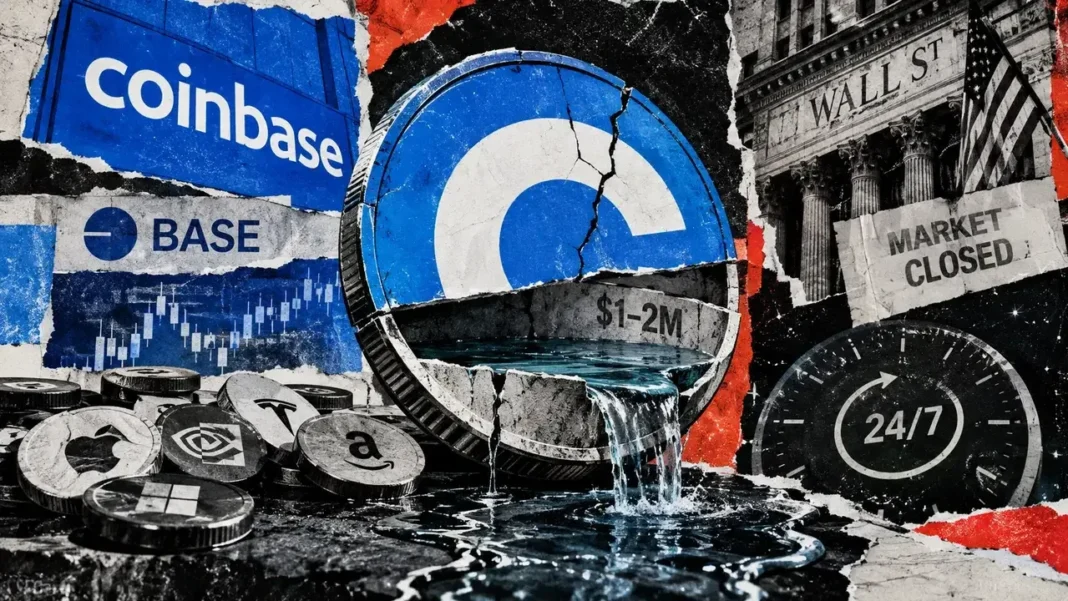

Reported trading exceeding $1 billion makes Coinbase’s stock tokens appear highly active. For any holder attempting to cash out, however, the critical questions are how much depth the market can absorb right away and at what price—especially outside of traditional US equity trading hours.
An examination on Sept. 23 revealed indicative buy and sell routes for roughly $100,000 across each of Coinbase’s ten stock tokens on Base. Estimated sales proceeds came in 0.06% to 0.71% lower than KyberSwap’s own dollar valuation for the offered tokens. While these routes price individual transactions at a single moment, they do not guarantee capacity for a simultaneous, large-scale selloff.
During the review, the ten primary Aerodrome stock/USDC pools held roughly $12.97 million in combined visible balances. Individual pools spanned from about $818,700 for MSFTc to $2.11 million for NVDAc, totals that encompass both the stock tokens and USDC. The aggregate figure alone fails to show the exact capital accessible to absorb a liquidation within a specific price band.
Data from Dromos Kitchen’s stock-token dashboard indicated cumulative trading volume reached roughly $1.02 billion alongside a total tokenized value of $19.82 million as of Sept. 23. This community-compiled data includes a disclaimer noting it might be incomplete. Because turnover builds up over time across multiple transactions, it cannot be interpreted as a fresh reservoir of buyers standing by for a major sell order.
What the $100,000 quotes show
The table pairs each visible Aerodrome pool balance with KyberSwap’s estimated execution paths for selling a stock token into USDC or purchasing one with USDC. The quote gap measures how far the router’s estimated dollar payout dropped below its own valuation of the input. This metric does not compare the token against the underlying share price on traditional exchanges, nor does it log a finalized trade.
| Token | Aerodrome stock/USDC pool | $100,000 sell quote gap | $100,000 buy quote gap |
|---|---|---|---|
| NVDAc | $2.11 million | 0.13% | 0.16% |
| AAPLc | $1.50 million | 0.06% | 0.10% |
| GOOGLc | $1.66 million | 0.10% | 0.09% |
| METAc | $2.10 million | 0.13% | 0.22% |
| AMZNc | $1.03 million | 0.30% | 0.22% |
| MSFTc | $818,700 | 0.39% | 0.43% |
| TSLAc | $861,985 | 0.42% | 0.51% |
| MSTRc | $940,283 | 0.71% | 0.76% |
| SNDKc | $952,629 | 0.61% | 0.69% |
| SPCXc | $1.00 million | 0.50% | 0.25% |
Method: Pool balances originate from the ten matching Aerodrome Slipstream 3 stock/USDC records captured near 08:00 UTC. KyberSwap GET route summaries were pulled between 08:02:01 and 08:02:42 UTC. Sell sizes approximated $100,000 based on displayed token prices, though KyberSwap’s input marks varied slightly. Figures are rounded, gas fees are excluded, and no actual transactions were submitted because the API requires an additional step to generate a transaction.
At roughly $10,000 per token, sell-side quote gaps ranged from 0.01% to 0.12%, whereas $100,000 orders generally widened those spreads. Certain routing paths aggregated Aerodrome liquidity with external sources, meaning estimated pricing reflects router reach beyond a single pool. That extended access can shift rapidly as market makers and liquidity providers adjust their quotes.
Visible pool balances rely in part on the incentives paid to liquidity providers to keep capital deployed. Under Aerodrome’s gauge criteria, providers who stake their pool positions to earn AERO emissions sacrifice direct swap-fee rewards, which are instead routed to voters directing those emissions. Consequently, fee generation and AERO distribution operate as separate components of a pool’s economics.
At the August launch, Beefy reported that Coinbase was supplying USDC incentives via Merkl over two-week windows, with Beefy supplementing them alongside Aerodrome emissions. This outlines how liquidity was initially stimulated rather than guaranteeing a fixed current yield for every stock pool. Should votes or incentives shift elsewhere, providers may reallocate their funds regardless of historical trading metrics.
This underlying funding structure becomes especially vital when token trading continues past traditional stock market hours.
According to Base, Coinbase’s tokens are backed by underlying equities held in regulated custody and remain accessible exclusively to qualified non-US jurisdictions. Developer documentation specifies that secondary token transactions are permissionless—subject to address controls—while primary minting and redemption of the underlying shares are restricted to authorized participants.
These tokens can exchange hands while traditional US markets remain closed. Base documentation notes that the Chainlink equity feed freezes at its final valuation outside market hours while onchain trading persists. Consequently, holders executing after-hours sales navigate an active token market where the underlying equity benchmark may still reflect the previous session’s close. Because authorized participants manage share creation and redemption separately, secondary-market liquidity providers alone dictate the price of an immediate exit.
The Sept. 23 routes indicate that $100,000 orders secured indicative prices despite modest pool balances. Any shift in AERO voting preferences, provider capital, or after-hours corporate developments could alter those routes while equity price feeds remain static.
Frequently Asked Questions
-
Do high trading volumes mean Coinbase stock tokens are fully liquid?
No. While cumulative volume has surpassed $1 billion, turnover accumulates across trades over time and does not represent a standing pool of buyers waiting to absorb a large selloff.
-
What happens to stock token prices when traditional US markets are closed?
Onchain token trading continues while the Chainlink equity feed holds its last value from the prior session, meaning after-hours traders face a live token market detached from live equity price updates.
-
Are Coinbase stock tokens available to US residents?
No, Base documentation states that the tokens are available exclusively in eligible jurisdictions outside the United States.
-
Who controls the creation and redemption of the underlying shares?
Primary minting and redemption are restricted to authorized participants, leaving secondary-market liquidity providers to determine immediate exit pricing.