

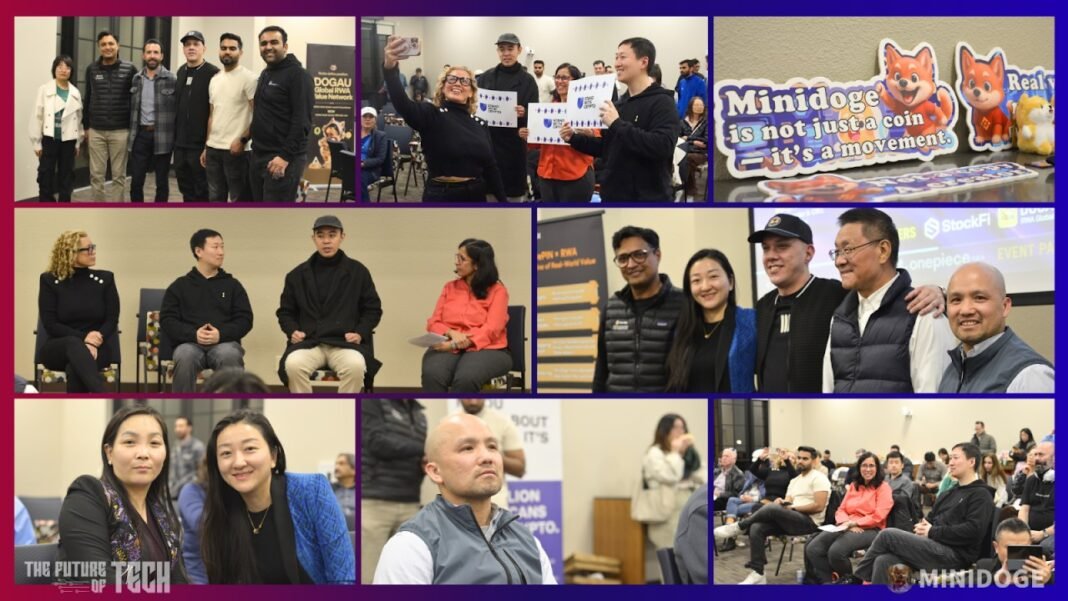

That quiet conviction echoed through the halls of Stanford University on the evening of February 2, 2026, as The Future of Tech: Stanford Forum 2026, powered by MiniDoge, brought together the builders, thinkers, and decision-makers actively shaping what comes next for AI, Web3, and global innovation.
The campus transformed into more than a venue—it became a crossroad. Founders compared notes with investors. Policymakers listened closely to builders. Technologists debated not just what could be built, but what should be built as decentralized systems, and AI moves from theory into everyday infrastructure.
This was The Future of Tech: Stanford Forum 2026—not a conference chasing headlines, but a curated evening designed to ask harder questions and surface clearer answers.
A Forum Designed for a New Tech Era
The tech industry is changing tones.
The era of unchecked hype cycles is giving way to something more grounded: real-world deployment, regulatory scrutiny, infrastructure maturity, and long-term accountability. As AI systems scale rapidly and Web3 infrastructure evolves beyond speculation, the need for honest, cross-disciplinary conversation has never been more urgent.
Stanford Forum 2026 was created precisely for this moment.
Curated by The Future of Tech and led by Orbis86, OffChain Global, and BrandPR, the forum intentionally stepped away from the traditional conference format. There were no crowded expo floors or surface-level pitches—only focused discussions, meaningful connections, and space for ideas to evolve into action.
Every detail of the evening was designed to move conversations forward.
How the Evening Unfolded
The evening began not with a rush to seats, but with a sense of anticipation.
As guests checked in and settled into the space, the atmosphere was intentionally different—warm, open, and quietly electric. Hosts, co-hosts, and sponsors welcomed attendees into an environment designed for exploration rather than performance. Conversations sparked easily, introductions flowed naturally, and the room filled with a shared curiosity about where Web3, AI, and emerging technologies are truly headed.
Before the panels began, sponsors and partners took a moment to share their vision. Rather than sales pitches, these were reflections—on why they’re building, what problems they’re solving, and how their work fits into a larger technological shift.
Speaking to this broader evolution, Tony from MiniDoge, emphasized that innovation today is no longer confined to code alone.
“Minidoge is not just a lie of code — it’s a living digital symbol filled with story, creativity, and imagination. We’re combining culture and technology to build long-term value.”
His remarks reinforced the tone of the evening: thoughtful, grounded, and forward-looking in the belief that the next phase of web3 will be shaped by projects that bridge infrastructure with real-world cultural relevance.
With the vision set, the forum transitioned into its first in-depth conversation of the night.
Bringing Trillions On-Chain: Compliance, Capital & the RWA Stack
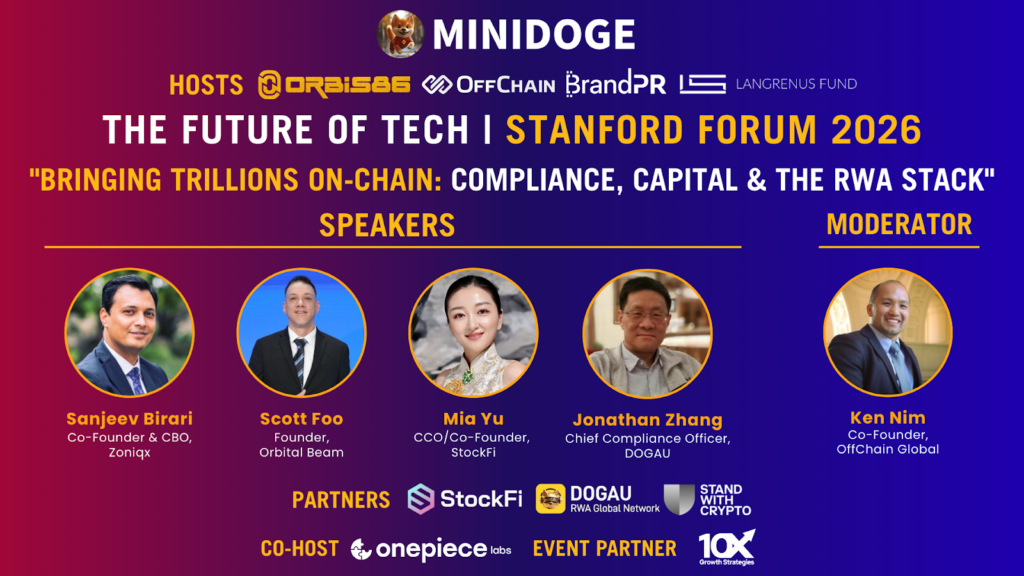
The first panel, moderated by Ken Nim of OffChain Global, addressed one of the most consequential challenges in Web3 today: how real-world assets move on-chain at true institutional scale.
Rather than idealizing the future, the discussion focused on execution—compliance, distribution, and trust.
“You can tokenize anything—but without compliance and regulation built in from day one, it will never scale,” shared Mia Yu of StockFi, highlighting why early RWA experiments struggled to gain traction.
Sanjeev Birari of Zoniqx echoed this reality, noting that “the biggest reason RWA hasn’t scaled isn’t technology—it’s distribution. Tokens are on-chain, but buyers aren’t.”
Jonathan Zhang, Chief Compliance officer of DOGAU, added an important institutional perspective, emphasizing that scalable RWA adoption depends on aligning on-chain, infrastructure with existing financial workflows and investor expectations. He noted that bridging traditional capital markets with blockchain systems requires not only technical readiness, but also trust, operational clarity, and seamless integration with legacy processes.
Guided by Nim’s moderation, panelists explored how institutional adoption requires more than smart contracts—it demands regulatory alignment across jurisdictions and access to credible buy-side networks. As Birari explained, “We’ve put regulation from over 20 jurisdictions on-chain already. Issuers can select the rules that apply and deploy assets in a compliant way without rebuilding everything.”
Scott Foo of Orbital Beam grounded the conversation further: “You can tokenize a thousand assets—but if there’s no buyer on the other side, what’s the point?”
Together, the panel made one thing clear: the next phase of RWA growth will be defined not by experimentation, but by infrastructure maturity, regulatory clarity, and long-term capital confidence.
Web3 Beyond the Experiment: The Road to 2026 & Beyond
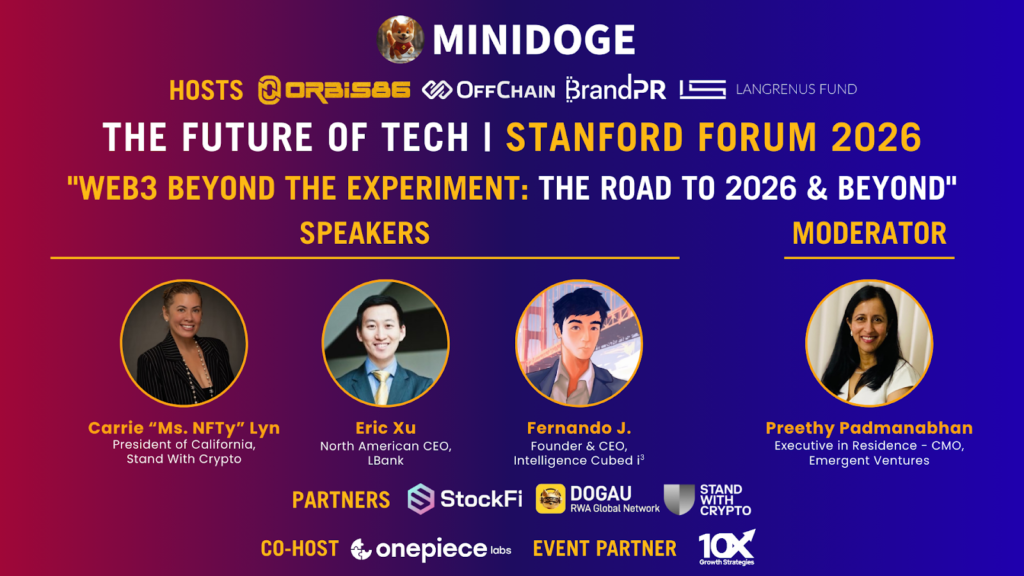
If the first panel examined the foundations of capital and compliance, the second shifted the conversation toward a more pressing question: how Web3 moves from experimentation into everyday relevance.
Moderated by Preethy Padmanabhan, Executive in Residence – CMO at Emergent Ventures, the discussion explored what real adoption looks like as infrastructure matures, regulatory frameworks become clearer, and AI increasingly intersects with decentralized systems. The focus was no longer on theoretical potential, but on usability, trust, and long-term value creation.
As one panelist observed, “The question is no longer whether Web3 will succeed—it’s how we make it matter in everyday life.”
Carrie “Ms. NFTy” Lyn of Stand With Crypto emphasized the role of builders in shaping that future, noting that “builders can see three, five, even ten years ahead—and policymakers need to hear directly from them as these rules are being written.” Her remarks reinforced the importance of aligning innovation with education and policy engagement.
Eric Xu of LBank pointed to tangible financial use cases as the catalyst for adoption. “Adoption happens when decentralized systems are more efficient, more transparent, and clearly better than what already exists,” he shared, highlighting payments and compliance as areas where blockchain is already delivering real value.
From an AI and infrastructure perspective,Fernando Jia,Founder & CEO, Intelligence Cubed i3 offered a broader lens on convergence. “Decentralized intelligence allows us to route tasks to the best-performing models in real time—something centralized systems can’t do,” he explained. In this emerging architecture, “blockchain becomes the connective layer linking data, models, and incentives.”
Taken together, the panel painted a realistic picture of the road ahead—one defined by patience, collaboration, and an honest understanding of user needs. The discussion made clear that Web3’s next chapter will not be shaped by experimentation alone, but by thoughtful execution and real-world relevance.
Ultimately, the question wasn’t whether Web3 would endure—but what builders must prioritize if they want their products to truly matter in 2026 and beyond.
Where Conversations Continued
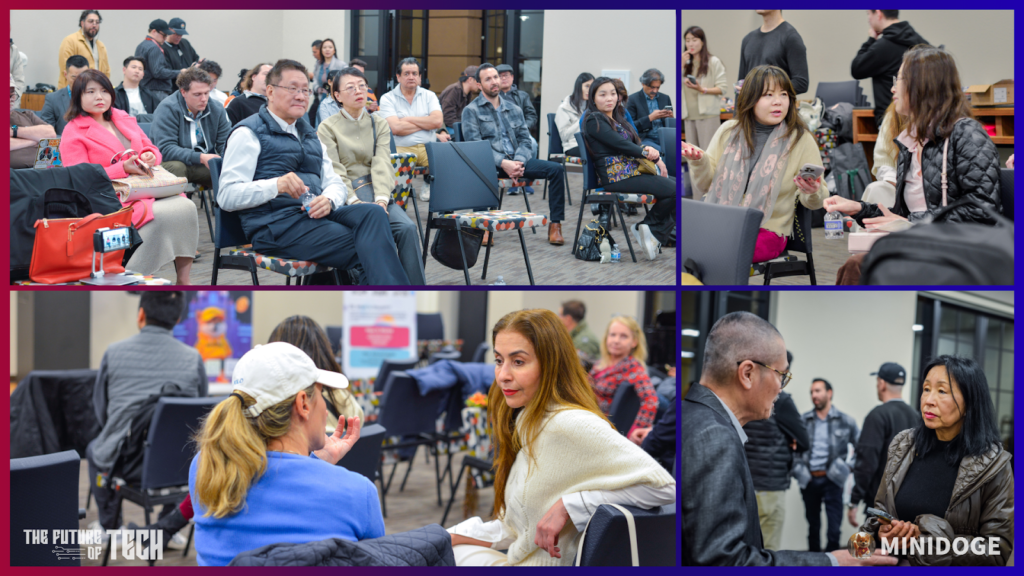
As the final panel concluded, the forum seamlessly transitioned into a curated networking mixer—where ideas moved off the stage and into real conversations.
Set against an inviting backdrop of curated bites and complimentary drinks, founders connected directly with investors, developers exchanged contacts and technical insights, and ecosystem leaders continued discussions sparked during the panels. Small groups formed and shifted throughout the room as introductions turned into follow-ups and early collaboration talks.
Builders, investors, and operators mingled freely, carrying the momentum of the evening forward. More than networking, it was a shared space to stay connected—where relationships began, and conversations set the stage for what comes next.
This was the forum’s heartbeat: an unstructured, high-signal space where relationships formed organically, and momentum carried forward long after the microphones were turned off.
Partners Powering the Vision
Stanford Forum 2026 was made possible through the support of sponsors and partners committed to advancing responsible innovation.
Lead Partner
MiniDoge: MiniDoge Global is a vibrant Web3 meme coin community fusing DeFi, DePIN, and AI-driven blockchain tech to revolutionize the crypto landscape.
Partners
Stand With Crypto – Stand With Crypto is a grassroot, nonpartisan movement uniting 2.5M+ advocates to support the future of crypto and blockchain innovation. Through education, policy engagement, and community-driven events, it empowers builders and supporters to shape fair digital asset legislation and the future of Web3.
StockFi: is a Web3-native financial platform bridging traditional finance and decentralized markets, with a focus on tokenized financial models, improved liquidity, and accessible on-chain participation.
DOGAU: is a community-driven Web3 project exploring the intersection of culture, engagement, and utility-led blockchain ecosystems, representing the growing role of community-first innovation in Web3.
The Teams Behind the Forum
Hosts
Orbis86: Orbis86 is revolutionizing emerging tech innovation through its Engage – Educate – Elevate approach, engaging users with personalized experiences, educating them on emerging technologies, and elevating their journey with seamless cross-chain integration. Throughout the year, we host global events that bring communities together to explore Web3 and AI, enabling meaningful discussions and collaboration.
OffChain Global: is a global community with 70+ chapters worldwide, bringing together Web3 professionals, tech enthusiasts, and entrepreneurs. Through regular meetups and talks, OffChain creates spaces to connect, collaborate, and grow local and global ecosystems.
BrandPR –is a leading PR and marketing agency partnering with Orbis86 to support Web3 brands globally. Since 2022, BrandPR has helped crypto and Web3 projects gain top-tier media exposure and build strong communities through tailored, high-impact PR strategies designed for long-term growth.
Langrenus Fund – is an early-stage investment and incubation fund founded by professionals from Google, Uber, and OKX. Focused on Web3 and AI, the fund supports founders from idea to launch through capital, incubation, and hands-on value creation, with a global footprint and 20+ successful showcases.
Co-host
OnePiece Labs– is a leading Web3 incubator founded by Silicon Valley entrepreneurs, supporting startups with mentorship, resources, and strategic networks to drive real outcomes. OnePiece Ventures is an early-stage crypto fund providing first-check capital and hands-on support to top founders across North America.
Event Partner
10X Growth Strategies– 10X Growth Strategies is a thriving Silicon Valley community bringing together investors, founders, and corporate executives to foster meaningful connections and long-term growth. Founded by Preethy Padmanabhan, the community hosts curated events across the San Francisco Bay Area, featuring leading venture capitalists and founders actively shaping the future of technology and innovation.
Media Partners
Helping amplify conversations at the intersection of AI, Web3, and emerging technologies, Stanford Forum 2026 was supported by a diverse group of media partners committed to thoughtful coverage and ecosystem education.
Our media partners include:
Bitcoin World | CoinPedia | CoinSpeaker | Voice of Crypto | Crypto News Bulls (CNB) | Blockzeit | Bitcoin Insider | Coin Zebro | Crypto Papers | Lucky Coiner | Trade Base | BD Ventures | Traders Brawl
Through their platforms, the ideas and insights shared at Stanford Forum 2026 continue to reach a global audience—extending the conversation far beyond the room and into the broader tech and innovation community.
Looking Ahead
Stanford Forum 2026 didn’t aim to predict the future—it aimed to clarify it.
By bringing together people focused on real impact, thoughtful regulation, and scalable systems, the forum reinforced a simple truth: the next era of technology will be built by those willing to collaborate, challenge assumptions, and commit to long-term value.
As conversations sparked at Stanford continue to evolve into partnerships, products, and policy discussions, The Future of Tech looks ahead to expanding this dialogue across global stages in 2026 and beyond